
A local retailer opens their campaign report and the numbers look great. Impressions are up, the CPM is low, the budget is fully spent. Then they ask a simple question: how many of those impressions were actually seen by a real person, on a site they would be comfortable appearing next to? Suddenly the dashboard looks a lot less reassuring.
This is the gap between what gets reported and what gets delivered. Three separate problems live in that gap: ad fraud, poor viewability, and brand safety incidents. They have different causes, but they share the same outcome, spend that does not translate into real value.

Fraudulent impressions often originate from server farms and infected devices rather than real people on real devices.
What does ad fraud actually look like?
Ad fraud covers any deliberate attempt to generate fake impressions, clicks, or conversions in order to collect advertising budget for nothing. It takes a handful of recognizable forms.
Bot traffic and invalid traffic (IVT). Scripts, bots, and infected devices can simulate page views at scale, and an advertiser pays for each one as though it came from a real person. The industry splits this into general IVT (traffic from known data center IPs and crawlers, filtered with standard methods) and sophisticated IVT (hijacked devices and falsified measurement data, much harder to catch).
Domain spoofing. A low-quality site misrepresents itself in the bid request, claiming to be a premium publisher it is not. The advertiser pays a premium CPM for inventory that never matches what they thought they bought. Ads.txt and sellers.json exist specifically to fight this, by creating a registry of authorized sellers.
Ad stacking and pixel stuffing. Stacking piles several ads on top of each other in one slot, so only the top one is visible but all of them get billed as served. Pixel stuffing shrinks an ad down to a single, invisible pixel, which still counts as an impression on the invoice.
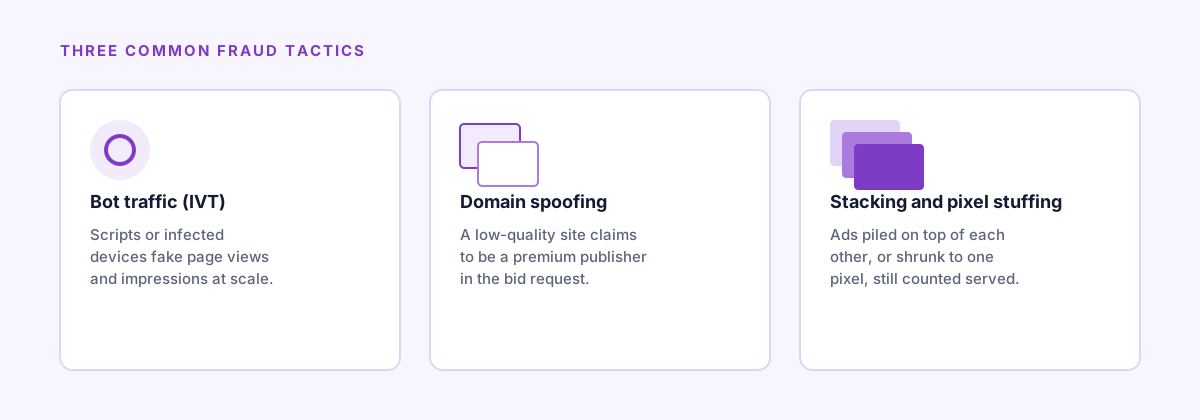
Three of the most common fraud tactics: fake traffic, a disguised domain, and ads billed without ever really being shown.
Viewability: served is not the same as seen
Even a perfectly legitimate impression can go unseen. It can load far down a page the visitor never scrolls to, or sit in a background browser tab nobody is looking at.
The Media Rating Council (MRC) sets the industry definition: a display ad counts as viewable once at least 50% of its pixels are visible for at least one continuous second. Video needs the same 50% for two continuous seconds.
A few things are worth keeping in mind here. Viewability rates vary a lot by format (video usually beats display), by placement (above the fold beats below it), and by device. Chasing 100% viewability is neither realistic nor necessarily smart, since a very high viewability floor can cut off a large share of available inventory. And viewability on its own is not proof of effectiveness: an ad can be technically viewable and still be completely ignored.
Viewability answers one question only: did the ad have a chance to be seen. It says nothing about whether anyone cared.
Independent measurement vendors, among them DoubleVerify, Integral Ad Science (IAS), and Moat, offer third-party viewability reporting that can sit alongside a platform’s own numbers, the same principle behind running your own tracking pixels for double tracking.
Brand safety: the company your ad keeps
Brand safety is about keeping a brand’s ads away from content that could damage its reputation. The usual suspects are extremist or violent material, misinformation, explicit content, and controversial news coverage that, while not inherently unsafe, still feels off-tone for a given brand.
The industry increasingly separates brand safety from brand suitability. Brand safety means avoiding genuinely harmful content. Brand suitability is narrower and more personal: a news article about a natural disaster might be perfectly safe for most brands, yet clash badly with the upbeat tone of a holiday promotion. Suitability depends on the brand, safety mostly does not.

Brand safety controls work like a lock on where an ad is allowed to appear, not on who sees it.
Enforcement usually relies on a combination of tools:
- Inclusion lists, advertising only on a pre-approved set of domains or apps.
- Exclusion lists, blocking known problematic domains, apps, or content categories.
- Contextual classification, using automated content analysis to score each page before an ad is served on it.
- Publisher allow and block controls, available in most DSPs, often built on a standard taxonomy like the IAB Content Taxonomy so categories can be filtered in bulk.
Why do these three problems show up together?
Fraud, poor viewability, and brand safety issues are not unrelated. Low-quality inventory tends to score badly on all three at once. A site built to host bots rarely has strong viewability either, and sites that tolerate fraudulent traffic often tolerate the kind of content a careful advertiser would want to avoid. Addressing all three with the same quality standards, rather than treating them as separate projects, tends to catch more of the actual problem.
Third-party verification tools can apply these quality filters before an ad is served or after, flagging or removing impressions that fail any of the thresholds involved.
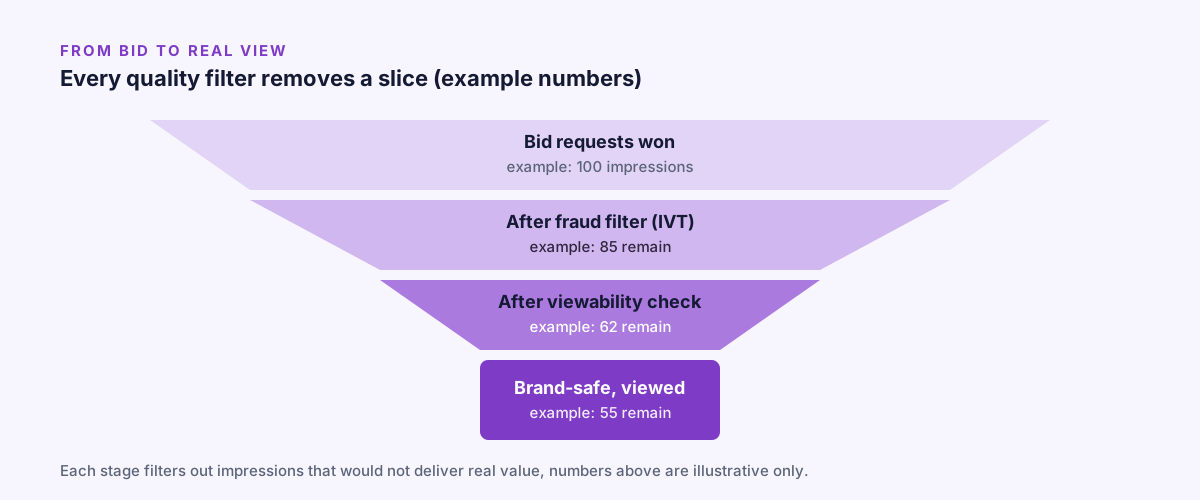
Each quality filter removes another slice. Applying all three together catches more than running them separately.
FAQ
Is a higher viewability rate always better?
Not necessarily. Pushing for a very high viewability floor can exclude a large share of available inventory, and a technically viewable ad is not automatically an effective one.
What is the difference between brand safety and brand suitability?
Brand safety means avoiding genuinely harmful content like violence or misinformation. Brand suitability is narrower and specific to a brand’s tone, since content that is safe for most advertisers can still clash with a particular campaign.
Can ad fraud happen even through a reputable DSP?
Reputable DSPs filter the obvious bot traffic and invalid traffic, but sophisticated IVT and domain spoofing can still slip through, which is why independent verification and your own tracking pixels are worth running alongside a platform’s own numbers.
Do allow and block lists stop ad fraud on their own?
They reduce exposure by keeping ads off known problem domains and apps, but pairing them with contextual classification and third-party verification catches more than lists alone.
How Arago helps
Arago bakes brand safety and viewability controls directly into campaign setup inside the DSP, so a local retailer can set the standards that matter to them without running a separate verification stack. Every line item gets allow and block lists for sites and apps, plus the option to add your own third-party tracking pixels and scripts for double tracking against Arago’s own numbers. Viewability is measured with the IAB Open Measurement SDK against the MRC standard, 50% of the ad visible for one continuous second, and reported per line item, creative, and ad size while the campaign runs. None of it requires a contract or a minimum spend, you only ever fund the campaigns themselves. See current pricing for details.