A page loads. Somewhere between the click and the first pixel painting on screen, a piece of software has already decided whether to bid on the ad slot you are about to see, and if so, exactly how much to offer. It made that decision in less time than it takes to blink, and it made a different one for the last hundred people who loaded that same page.
No analyst sitting at a desk could keep up with that pace. Machine learning can, and ai programmatic bidding has quietly become the part of advertising that decides almost everything else.

Every bid decision is, underneath the auction mechanics, a small prediction made by a model.
What four questions does an AI bidder answer?
Strip away the jargon and a bidding engine is really just answering four questions, one after another, for every single impression it sees, inside the 100-millisecond ad auction that happens before the page finishes loading.
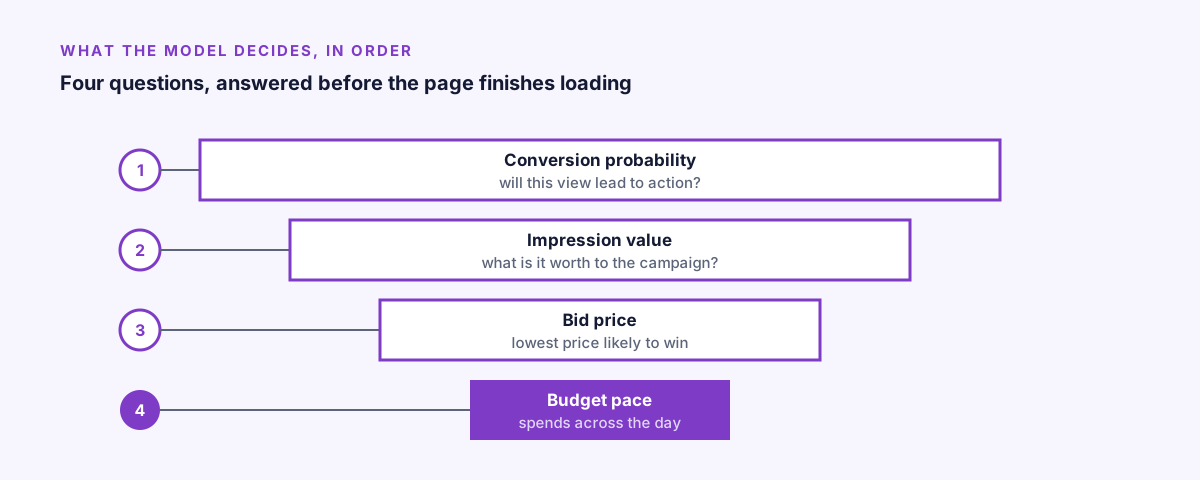
Each layer depends on the one above it. A bad answer early in the stack throws off everything that follows.
First, how likely is this specific view to lead to the outcome the campaign wants? Second, given that probability, what is this particular impression actually worth to the advertiser, not just its floor price? Third, what price is high enough to have a good shot at winning without paying more than necessary? And fourth, zooming out from any single impression, how should spend be spread across the day so the budget does not run out by lunchtime?
What data feeds the conversion model?
The conversion probability model is where most of the heavy lifting happens, and it leans on signals that have nothing to do with who the person is by name: the page category, the time of day, the device and connection type, how a user’s behavioural segment has performed before, and how the specific creative has performed with similar audiences. Each of those signals is cheap to compute on its own, but combined through training on historical impression and conversion data, usually via gradient boosting or a neural network rather than a hand-written rule, they capture patterns no analyst would think to write down. The model turns all of that into a single score, a probability, that the rest of the pipeline treats as ground truth.
The model does not know the person. It knows the pattern, and the pattern is usually enough.
Why did bidding get more careful?
For years, second-price auctions made the math simple: bid your true value, and the mechanism itself protected you from overpaying, since you only ever paid one increment above the next-best bid. As first-price auctions spread, that protection disappeared. Winners now pay exactly what they bid, which means bidding your full value is an easy way to overpay.
Bid shading is the industry’s answer. A shading model estimates the likely clearing price for similar inventory from historical patterns and shaves the bid down to the lowest amount still likely to win. Done well, it quietly lowers average CPMs without meaningfully hurting win rates, which simply means the same budget buys more impressions. The mechanics behind the auction itself are explained in more detail in our guide to real-time bidding.
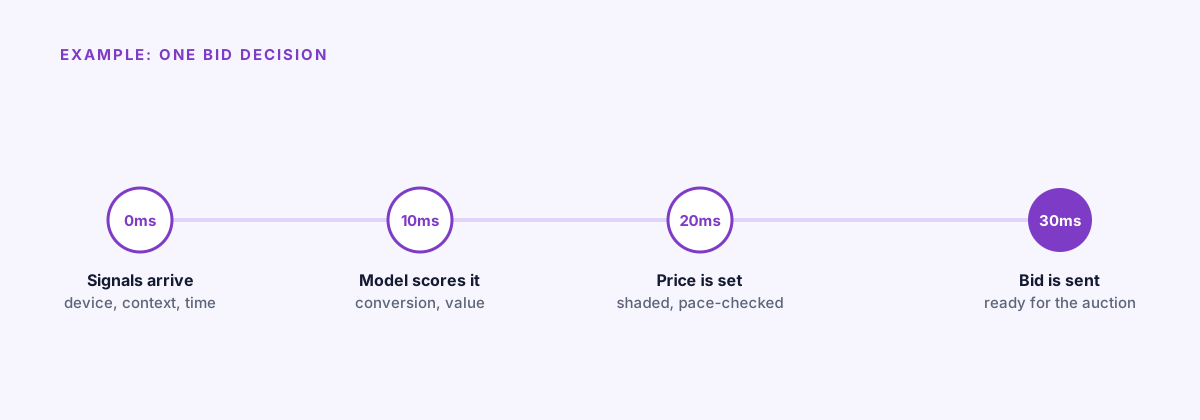
An illustrative example of how little time a model actually has: the whole chain, from signal to sent bid, fits inside a fraction of the overall auction window.
Spending the budget evenly, not eagerly
A model left entirely to its own devices would happily spend an entire day’s budget in the first hour, when competition is thinnest and winning is cheapest. Pacing exists to stop that. Simple pacing smooths spend across the day. Goal-based pacing goes further, aiming to hit a specific delivery target, a number of impressions or a cost-per-acquisition, by the end of the flight rather than just spreading money evenly.

Every one of these predictions runs on real infrastructure, scored fresh for every impression rather than cached and reused.
The same underlying technique powers lookalike modelling: starting from a seed audience of people who already converted, a model finds others with similar behavioural patterns, letting an advertiser scale past their known audience without guessing blindly.
Where does AI bidding still fall short?
None of this works without data, and early in a campaign there simply is not enough of it yet. That cold start period tends to show worse results before the model has collected enough signal to optimise properly, which is a normal phase, not a failure. Models also optimise exactly toward whatever they are told to measure, so a poorly defined conversion event, or noisy training data, sends the whole system chasing the wrong goal. And because the decision logic of a complex model is genuinely hard to inspect, troubleshooting an underperforming campaign often means working from outcomes rather than a clean explanation of cause. Watching the metrics that actually matter for your own line items is the best way to catch a drift early.
FAQ
Does AI bidding replace the need for campaign rules?
No. The model decides price and pacing inside the boundaries a human sets: which zones, which sites, and what budget. Rules define where the AI is allowed to operate, not the other way round.
How quickly can a bidding model learn a new campaign?
It depends on volume. A campaign with thousands of daily impressions can leave the cold-start phase within days, while a small, narrowly targeted campaign may take longer simply because there are fewer outcomes to learn from.
Is bid shading the same as underbidding?
No. Underbidding means offering less than an impression is worth and losing auctions you should win. Bid shading estimates the lowest price still likely to clear, so it lowers cost without meaningfully lowering win rate.
Can a small advertiser use AI bidding without a data science team?
Yes, as long as the platform runs the scoring itself. The advertiser sets zone, site and budget rules, and the model handles the per-impression decisions described above, the same way it would for a larger team.
How Arago helps
Arago bids on every view by default, using the rules you set for zone, allowed sites and budget as the boundaries the AI operates inside. That means a local retailer gets the same kind of per-impression decision-making described above, without needing a data science team, a cold-start budget set aside, or a separate bidding tool to configure.
Because reporting on impressions, clicks, CTR, viewable impressions and CPM is available per line item while the campaign runs, you can see how the model is actually performing for your specific zones and creatives, not just for the account as a whole. Set up your first line items in the DSP or draw your zones in Map.