
It is a Tuesday evening. Someone puts their feet up, opens a streaming app, and presses play on a show they have been meaning to watch. A few minutes in, the show pauses for an ad break. Nothing about the moment looks different from the cable box their parents had. But behind that paused screen, an auction just happened, and it decided exactly which ad they would see.
That is connected TV (CTV) advertising, and it has quietly become one of the more interesting corners of the ad industry: the biggest screen in the house, bought the way the rest of the internet is bought.

Same couch, same screen. The ad that plays, though, is decided in real time.
What does connected TV actually mean?
Connected TV is any television set that gets its content over the internet instead of (or alongside) a broadcast signal: a smart TV, a streaming stick plugged into an older set, a games console used to watch shows. The content itself, whether it is a subscription series, a free ad-supported channel, or a broadcaster’s catch-up service, is usually called streaming TV or over-the-top (OTT) video.
The ads that appear inside that content are what the industry calls CTV advertising. It looks like a normal TV ad break. It is sold nothing like one.
The old way and the new way
For decades, buying a TV ad meant buying a rough guess. You picked a channel and a time slot because a certain kind of audience was statistically likely to be watching, then hoped. There was no way to know who actually saw the ad, and no way to change course once it was booked.
Linear TV sells you an audience estimate. Connected TV sells you an actual view.
CTV flips that around. Because every stream runs through an internet connection, the platform knows, within limits, which household or device is watching. That single fact changes everything downstream: targeting, measurement, and how quickly you can react.
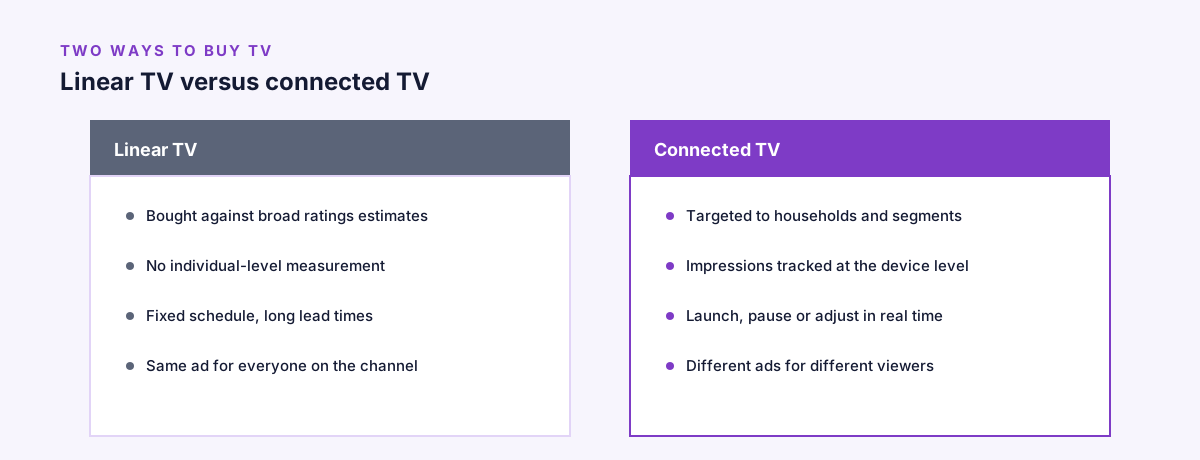
The same screen, bought two different ways: broad estimates versus addressable, measurable views.
Who is actually involved in a CTV ad buy?
A CTV ad does not travel from “advertiser” straight to “television.” A handful of players sit in between, each handling one part of the trip:
- Streaming publishers and platforms own the content and the ad breaks inside it: subscription services with an ad tier, free ad-supported channels, and catch-up TV.
- SSPs and ad servers manage that inventory on the publisher’s behalf and connect it to buyers.
- DSPs let advertisers bid on CTV inventory alongside their other digital campaigns, the same way they bid in a standard real-time bidding auction.
- Identity and data providers help match an advertiser’s target audience to the right streaming households.
- Measurement partners track whether the ad was actually watched, and for how long.
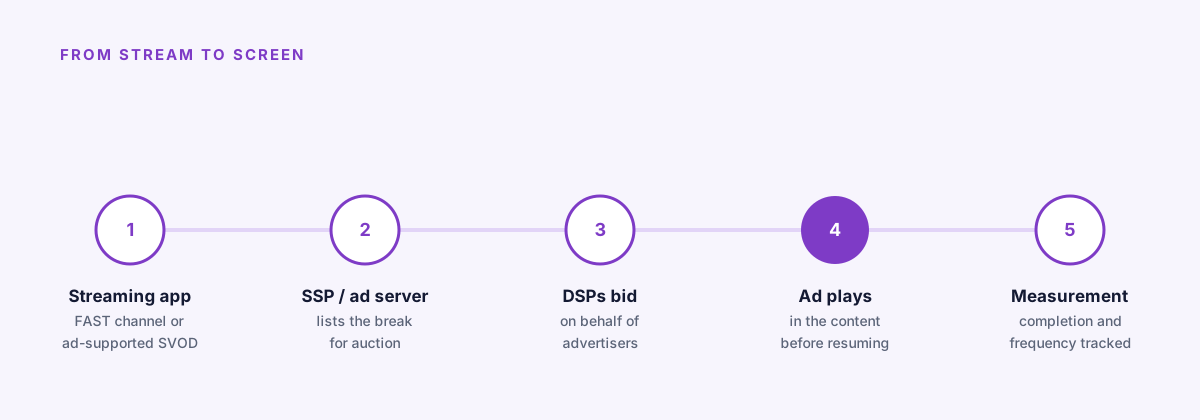
From the moment a show pauses for a break to the moment an ad plays, a short chain of handoffs decides what you see.
How is CTV inventory actually bought?
CTV inventory is sold through a mix of programmatic and direct deals. A lot of the best placements, the ones inside the most popular shows, are sold through programmatic guaranteed or private marketplace deals: an advertiser commits in advance, the publisher keeps control over who buys its premium slots, and pricing stays predictable on both sides.
Open auction CTV also exists, and it works closer to standard real-time bidding: any connected buyer can bid on any available slot as it becomes available. It tends to be cheaper, but the quality and context of the content it runs in is more variable.
One number that comes up constantly in CTV reporting is the video completion rate, or VCR: the share of an ad that people actually watch to the end. CTV completion rates tend to run high. Many CTV placements cannot be skipped, and people who are mid-episode are less likely to look away than someone scrolling a feed.

What can you actually target with CTV?
CTV opens up targeting options that simply do not exist on a broadcast channel:
- Household and demographic targeting, based on age, income or family composition.
- Geographic targeting, down to a city or even a postal code.
- Audience segments, built from first-party data, third-party data, or lookalike modelling.
- Contextual targeting, matching an ad to a genre, a content type or a specific app.
- Retargeting, reaching people who have already interacted with the brand elsewhere online.
As third-party cookies disappear from more of the open web, CTV’s reliance on device and household-level signals (rather than a cookie that can be blocked) keeps it relatively resilient for audience targeting.
What can you actually measure with CTV?
This is the part linear TV never offered. With CTV, you can track:
- Impression delivery and completion rates.
- Frequency capping, across devices and households, so the same person is not shown the same ad fifty times.
- Brand lift: whether awareness or intent shifted, usually measured through surveys.
- Conversions, both online actions and, for retailers, store visits tied back to the exposure.
Connecting a CTV exposure to something that person later did on their phone or laptop (cross-device measurement) is still an area the whole industry is actively working on. It is improving, but it is not a solved problem yet.
FAQ
Is connected TV advertising the same as streaming TV?
Not quite. Streaming TV, or OTT, describes the content itself. Connected TV advertising describes the ads that run inside that content and how they are bought, usually programmatically rather than by phone call.
Can viewers skip a connected TV ad?
Rarely. Most CTV placements run as non-skippable breaks inside the content, which is part of why video completion rates tend to run high compared with other digital video formats.
Is connected TV cheaper than linear TV?
It depends on the deal type. Open auction CTV tends to be cheaper than a negotiated linear TV slot, while premium programmatic guaranteed placements inside popular shows can cost closer to traditional TV rates.
Does running connected TV ads require a separate TV budget?
No. Because CTV is bought through the same programmatic pipes as display or programmatic DOOH, it can sit inside a single digital budget rather than a separate line reserved for television.
How Arago helps
Today, Arago lets local retail advertisers run display and interactive rich media campaigns from one account, with zones drawn in Map around real drive-time catchment areas and formats built in Creative, all without a minimum spend or a contract to sign first. Connected TV is on the roadmap, so a retailer already running display through Arago will be able to add TV to the same line items without switching platforms.