
You have felt this before, probably this week. You look at a product once, and for the next three days it follows you from site to site, app to app, as if it has something to prove. By the fourth sighting you are not thinking about the product anymore. You are thinking about how to make it stop.
That feeling has a name in advertising: overexposure. And the tool built specifically to prevent it has a plain, unglamorous name too: frequency capping.

Every device carries an identifier a platform can use to count how many times it has already shown an ad.
The simple rule behind a messy problem
A frequency cap is a rule: show this creative to this person no more than a set number of times in a given window, a day, a week, or the length of a campaign. Most demand-side platforms track this using cookie IDs, device IDs, or other identifiers, counting impressions per user as the campaign runs.
Caps can live at different levels, and the level matters:
- Campaign level: a ceiling on total impressions across every creative and placement.
- Line item or ad group level: a ceiling for a specific targeting segment.
- Creative level: a ceiling for one specific ad unit, which is the fastest way to prevent fatigue with a single message.
A tight cap at the creative level keeps any one ad from wearing out its welcome, while a cap at the campaign level controls how much of a person’s day a brand occupies overall.
Two very different reasons this matters
It protects how people feel about the brand. Overexposure is one of the most reliable ways to turn a neutral impression into a negative one. Someone who sees the same banner twice probably does not register it as an opinion at all. Someone who sees it ten times in a day starts to resent it, and that resentment attaches to the brand, not the ad server.
It protects the budget. Once a person has seen an ad several times, each additional impression to them tends to produce less and less. Money spent on the twelfth view of the same person is, in most cases, money that would have done more good reaching someone who had not been reached yet. In an open auction, where every impression is bought in real time, a single very active device can otherwise soak up a disproportionate share of a budget simply by generating more bid requests than everyone else.
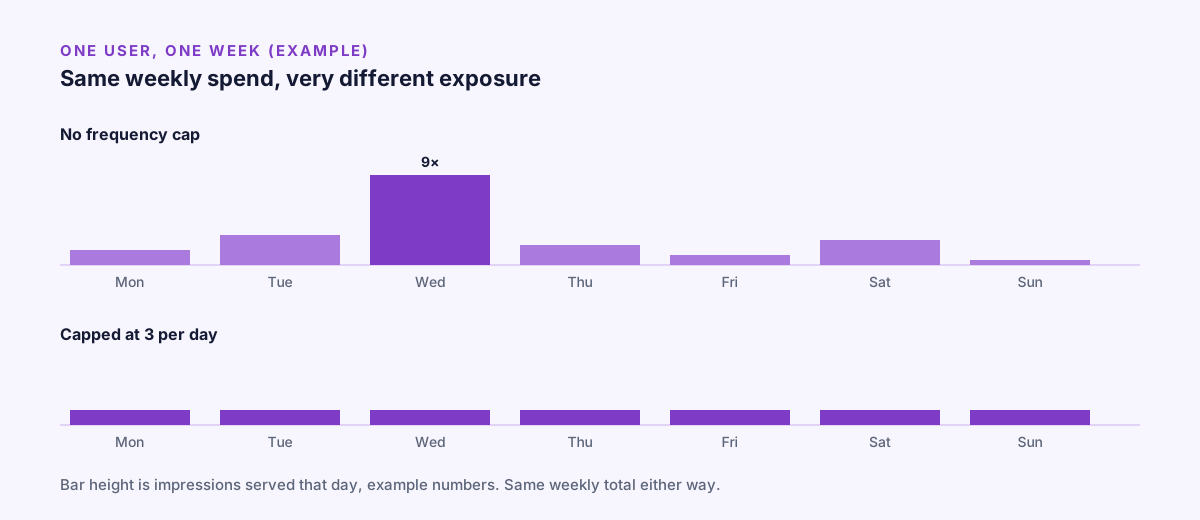
Without a cap, one unusually active day can absorb far more of a user’s weekly impressions than intended. Capping flattens that spike without changing the total spend.
The trade-off nobody gets to skip
Here is the part that makes frequency capping harder than it sounds: a single exposure is almost never enough. Research on advertising consistently finds that some repetition helps, and the right number of exposures depends on what the campaign is trying to do.
There is no universal right frequency. There is only the point where one more exposure stops adding value and starts costing goodwill.
A brand awareness campaign generally benefits from reaching more people at a lower frequency each. A retargeting campaign aimed at someone close to a decision often works best with a tighter frequency over a short window. Video formats tend to need fewer repeats to register than display does. And a category with a long consideration period, like furniture or cars, can benefit from moderate, sustained exposure over weeks rather than a short burst.
The rest of the audience management toolbox
Frequency capping is the most familiar tool, but it is one of several that work together to decide who sees what, and how often.
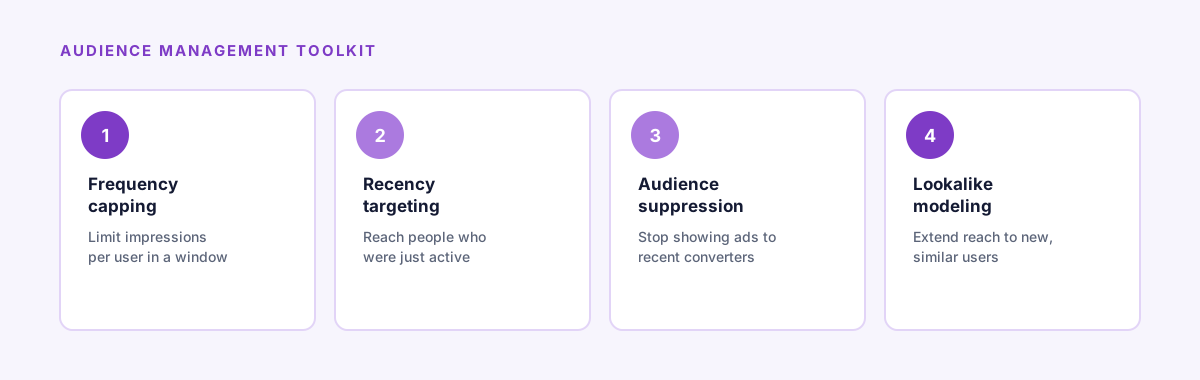
Frequency capping sets a ceiling. The other three tools decide who is worth reaching at all, and who to leave alone.
Recency targeting focuses impressions on people who were just active, someone who visited a store’s website in the last three days, for example, rather than spreading evenly across everyone who ever showed interest.
Audience suppression removes people who already converted from the eligible audience, which avoids the particular annoyance of being retargeted for something you just bought. Suppression lists usually come from first-party CRM data or conversion pixels.
Sequential messaging turns frequency from a ceiling into a structure, showing a broad awareness message first, a product-specific ad second, and a promotional offer last, as the same person accumulates exposures.
Lookalike modeling extends reach once a high-value segment runs out of new people to show ads to, by finding new users who resemble the best-performing segment.

A crowd like this contains thousands of separate frequency counters, one per device, each one reset by its own identifier.
How do identifiers complicate frequency capping?
Frequency capping is only as accurate as the identifier behind it. In a cookieless or cross-device environment, the same human being can show up under several different identifiers and end up seeing more impressions than intended, simply because the system cannot tell it is the same person. Probabilistic identity resolution, linking several devices to one likely household, helps close that gap, though it introduces its own margin of error. On mobile apps, device identifiers like IDFA on iOS and GAID on Android have historically given more reliable counts than web cookies, though platform privacy changes have made that less clean-cut than it used to be.
FAQ
What is a frequency cap in advertising?
A frequency cap is a rule that limits how many times the same person can be shown one ad, one line item, or one campaign within a set window such as a day or a week.
What is a good frequency capping rule of thumb?
There is no universal number. A brand awareness campaign often works at a lower frequency spread across more people, while a tight retargeting window close to a decision often tolerates a higher one.
Does frequency capping work the same on mobile apps and websites?
Not exactly. Mobile apps generally rely on device identifiers like IDFA or GAID, which have historically tracked more reliably than web cookies, though privacy changes have narrowed that gap.
Can frequency capping replace audience suppression?
No. A frequency cap limits repeat views of a single ad, while audience suppression removes people who already converted from the eligible audience entirely, which is a different problem.
How Arago helps
Arago gives every line item its own frequency capping controls, set independently for each place, budget, and ad you run, whether that is three line items for a citywide launch or one hundred and twenty for a chain with a store in every town. You can pair that with an IFA (device ID) block list per line item and your own third-party tracking pixels, so people whose device IDs you already hold stop seeing the ad and you can double-check delivery against your own ad server. All of it lives inside the DSP alongside the rest of your targeting: sites and apps, devices, languages, and drive-time zones around each store from Map. There is no contract and no minimum spend, you only fund the campaigns you run.