
A cashier taps a loyalty card against a reader. The till beeps, the receipt prints, and somewhere in the back office a database quietly logs one more purchase against one more customer. That is first-party data, created in about a second, and in most stores it goes on to do exactly nothing.

Every transaction here creates a data point. The question a first-party data strategy answers is what happens to it next.
As the ad ecosystem moves away from third-party identifiers, this kind of data, the kind you already own, has become one of the most valuable assets a brand or retailer can hold. Collecting it was never really the hard part. Structuring it, governing it and actually activating it is where most first-party data strategies stall.
What actually counts as first-party data
First-party data is anything collected directly from your own customers through their interactions with your brand: purchase history and transaction records, website and app behavior, email and CRM records, loyalty program activity, and in-store interactions wherever they get captured digitally. Because it comes from a consented relationship between you and the customer, it tends to be both the most accurate and the most privacy-resilient audience data you can get.

One checkout, several signals at once: what was bought, by whom, and how they paid.
Why it matters more this year than last
A few structural shifts pushed first-party data from “nice to have” to foundational. Cookie deprecation removed the identifier that underpinned much of programmatic targeting for over a decade. Mobile signal loss followed a similar path: Apple’s device identifier became opt-in by default after iOS 14, cutting addressability on mobile sharply. And privacy regulation, GDPR in Europe and a growing list of state laws in North America, has made third-party data meaningfully harder to use without running into consent requirements. None of that makes advertising impossible. It just makes your own data the part of the stack you can actually count on.
The data you collect yourself is the only kind that does not get weaker every time a browser or a regulator changes the rules on someone else’s tracking.
From raw records to something you can target
Collecting the data is step one. On its own, a pile of transaction records and email addresses does not target anything. It needs a path from the till, the website and the CRM into something a campaign can actually use.
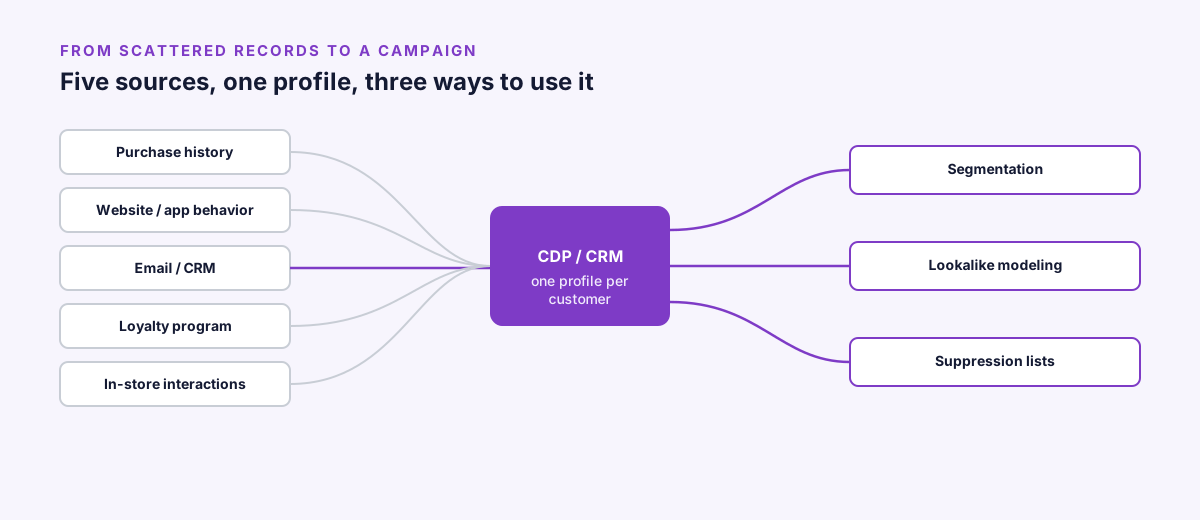
Five scattered sources, one unified profile, three ways to put it to work.
A customer data platform or a well-structured CRM is usually what does the unifying, pulling records from your e-commerce platform, your point-of-sale system, your email provider and your loyalty program into one profile per customer instead of four disconnected ones.
From there, three activation patterns cover most of what advertisers actually do with the result:
- Segmentation: grouping customers by behavior that matters, high-value purchasers, lapsed customers, category loyalists, first-time buyers, so each group can be targeted on its own terms.
- Lookalike modeling: using a defined seed audience, say your top purchasers by spend, to find similar profiles across programmatic inventory. A seed list with real behavioral signal behind it produces a much better lookalike than a generic customer export.
- Suppression: using the same data to decide who not to target, excluding recent purchasers from acquisition campaigns or dropping churned customers from upsell messaging, which cuts wasted spend without anyone noticing the exclusion.
Collection and consent come before any of it
None of this works without getting the basics right first. Before collecting anything, tell people clearly what you are collecting and why: consent banners and preference centers are not just a legal checkbox, they build the trust that makes future collection sustainable. Resist the urge to collect everything you technically can. A local retailer usually gets more value from purchase frequency, preferred categories and store proximity than from granular browsing behavior nobody will ever act on.
Governance is what keeps the strategy standing
A first-party data strategy is only as strong as the governance holding it up: minimizing what you collect and how long you keep it, limiting who inside the organization can touch raw customer records, putting real data processing agreements in place before sharing anything with an ad platform or DSP, and keeping an audit trail of what was collected, when, under what consent, and how it got used.
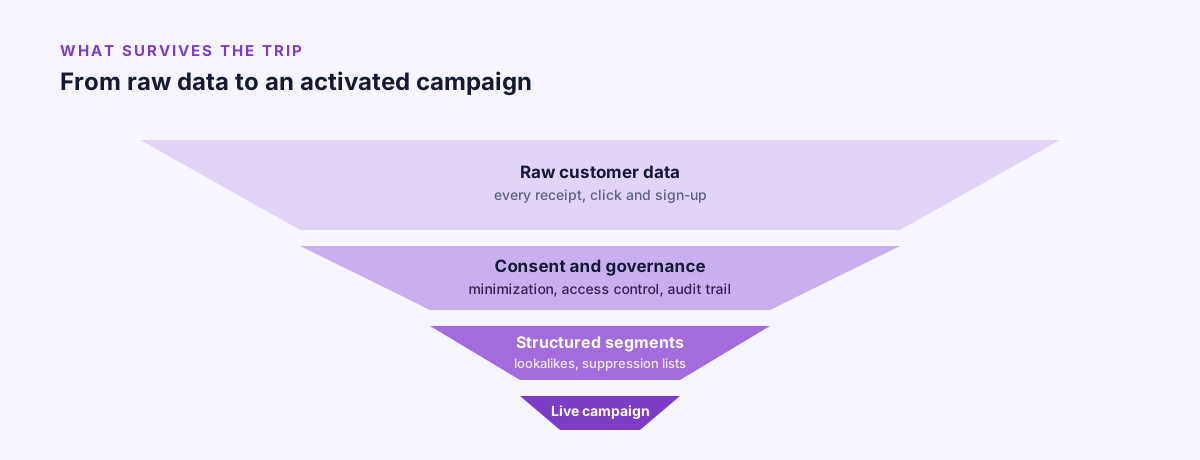
Most of what you collect never reaches a campaign. Governance is the filter that decides what survives the trip.
Checking whether it is actually working
Periodically it is worth asking some plain questions about the strategy rather than assuming it is paying off: what share of your transactions can you link to a known, consented customer profile, how fresh are the segments you are targeting against, and what match rate do you get when that CRM list is uploaded to a DSP or a walled garden. None of these need a sophisticated dashboard. They just need an honest answer, repeated often enough to catch drift early.
FAQ
Do I need a customer data platform to get started?
Not on day one. A well-structured CRM or even a clean spreadsheet can support basic segmentation and suppression. A CDP becomes worth the investment once you are unifying several sources and need the result to stay fresh automatically.
What is the difference between first-party and zero-party data?
First-party data is inferred from behavior you observe, like purchase history or browsing. Zero-party data is what a customer tells you directly, through a preference form or a survey. Both come from a consented relationship and both belong in the same strategy.
What counts as a good match rate when uploading a customer list to a DSP?
It depends on list quality and the platform, but a list built from accurate, deduplicated emails or phone numbers typically matches noticeably better than one scraped together from partial records. Treat match rate as a metric to track over time, not a one-off number.
Does first-party data replace the need for prospecting campaigns?
No. First-party data is strongest for retention, suppression and lookalike seeding. Reaching people who have never interacted with your brand still relies on contextual targeting, location signals and broader programmatic reach.
How Arago helps
Arago is built for exactly the gap most local retailers have: first-party knowledge of where their customers actually are, tied to the store rather than a generic metro area. In the DSP, that means a drive-time zone drawn in Map for each store and one line item per store, with Creative personalized per location and IFA (device ID) exclusion lists to keep a line item from reaching people already converted, all with no contract or minimum spend to get started. For the identifiers that help this data travel across a DSP’s inventory, see identity resolution and alternative IDs, and for the browser-level shift behind all of this, cookieless advertising.