
This morning, on a train, you scrolled through a backpack on your phone. Tonight, on the sofa, you opened your laptop and bought it. To you, that is obviously one errand. To most ad systems, until someone does some work, that is two unrelated strangers who happen to like the same backpack.

From the outside, a crowd of signals. Identity resolution is the work of noticing that two of those signals are the same person.
Identity resolution is the name for that work: linking scattered data points, a mobile device, an email address, a loyalty card number, a browser session, into one profile that represents a real customer. Done well, nobody notices it happening. Done badly, you get the symptoms everyone recognizes:
- The same ad shown to the same person three times in one evening, on three different devices.
- A sale that happened but never got credited to the campaign that caused it.
- A frequency cap that resets itself every time someone switches screens.
- An audience segment that is quietly less accurate than it looks.
None of these are abstract annoyances. Each one costs money: wasted impressions, undercounted sales, and segments that drift further from reality every week they go unchecked.
Two ways to connect the dots
Every identity resolution method falls into one of two families, and most real systems use both. The choice between them is less about which is “better” and more about which moment in the customer journey you are trying to recognize.
Deterministic matching relies on a known, consistent identifier, usually a hashed email address or phone number, to link records with high confidence. When someone logs into an app with their email, that signal is about as certain as signals get. It is accurate, but it only covers moments when someone is authenticated, which is a fraction of all digital activity.
Probabilistic matching uses statistical inference instead: IP address, device type, browser fingerprint, behavioral patterns, combined to suggest that two sessions likely belong to the same person, even without a definitive identifier. It extends reach well beyond what deterministic matching alone could cover, at the cost of some uncertainty that grows as signals drift over time.
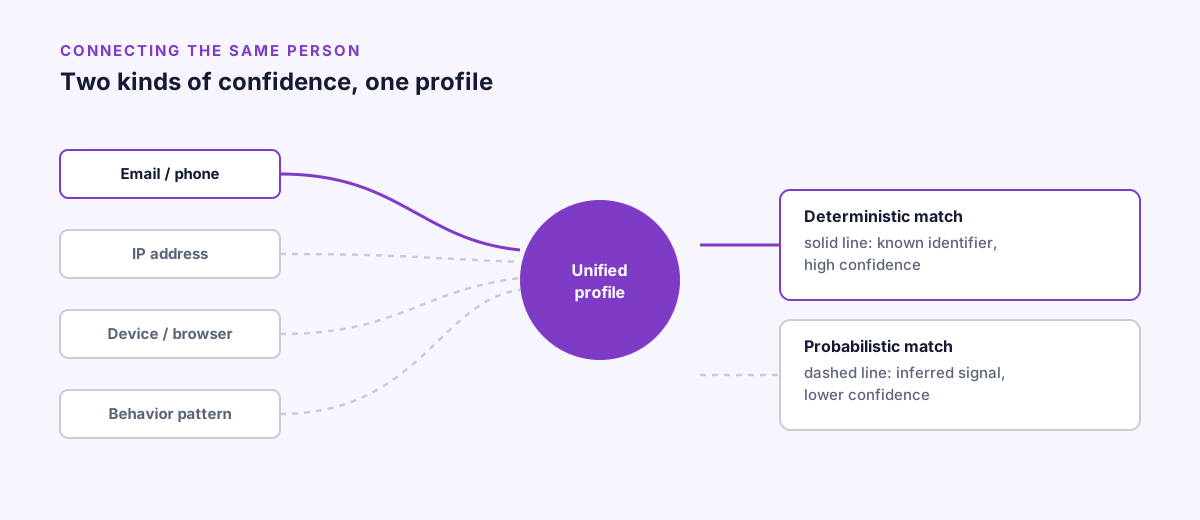
A known email or phone number links records with certainty. Everything else gets inferred, and inference always carries some uncertainty.
Most identity graphs that work well in practice are not purely one or the other. They anchor on deterministic matches wherever those exist, and lean on probabilistic inference to extend coverage around them.
Why the cookie used to carry this load
For two decades, the third-party cookie acted as the open web’s default identity layer. It let advertisers track a browser across sites, build cross-site behavioral profiles, and serve retargeted ads without needing a login anywhere. As browsers restricted or removed third-party cookies, that mechanism stopped working the way it used to.

Three screens, one shopper. Recognizing that without a shared cookie is exactly the problem alternative IDs try to solve.
The practical fallout: cross-site audience segments get harder to build and keep fresh, retargeting leans more heavily on authenticated signals or a publisher’s own first-party data, frequency management across sites becomes unreliable, and attribution models that assumed a cookie would always be there need rethinking.
The alternatives, positioned against each other
The industry’s response has been a handful of approaches, each trading off reach against precision in a different way.
- Email-based IDs such as Unified ID 2.0 and RampID hash an authenticated email address into a persistent identifier, matched against the same hash held by advertisers and DSPs. Reach depends entirely on how widely a given publisher or consumer has opted in.
- Publisher first-party IDs assign a persistent ID to logged-in users on one publisher’s own properties. Highly accurate there, but they do not carry across unrelated sites without a shared identity graph.
- Contextual signals skip identity altogether and target the content being read instead, using language processing to judge relevance to a topic or product category.
- Device graphs and IP-based approaches link devices to a household using a mix of deterministic and probabilistic signals, useful as a coarse proxy but limited on shared networks.
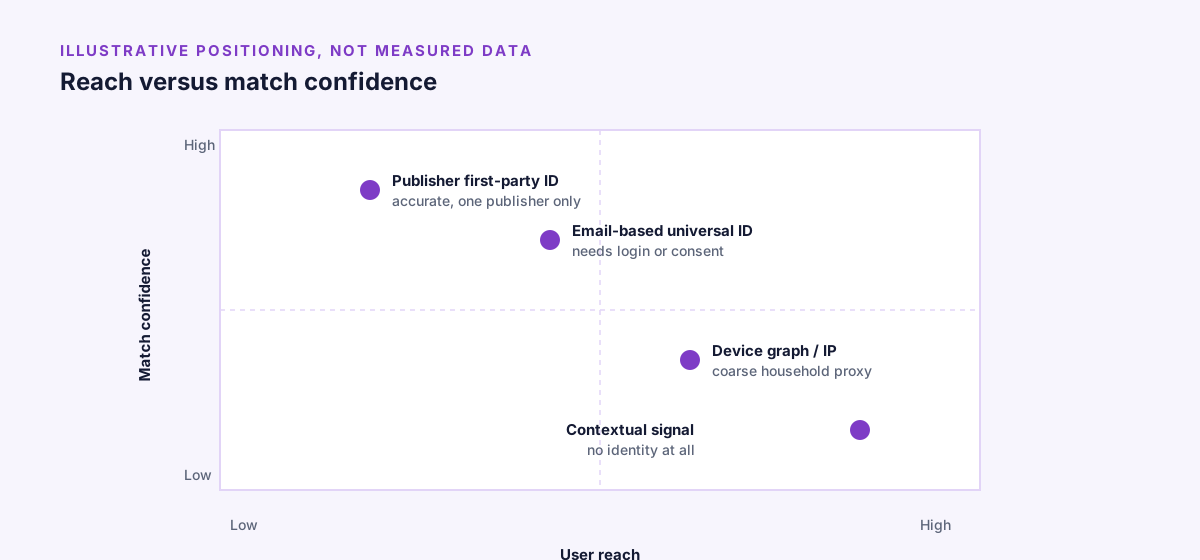
An illustrative positioning, not a measurement: contextual signals reach the widest audience with no identity attached, while a login-based ID trades reach for near-certain confidence.
Privacy is a design choice, not a side effect
None of these alternatives is automatically privacy-safe. That depends entirely on how each one is built and run. The questions worth asking of any identifier are the same every time: was consent collected before the identifier was created, can a user opt out and have it deleted, and does it enable cross-site tracking in ways people would not expect. The identity solutions that hold up are the ones built around explicit consent with clear controls, not the ones that simply found a new technical path around the old cookie.
FAQ
Does identity resolution need a login to work?
Not entirely. Deterministic matches need an authenticated moment such as a login, but probabilistic matching fills the gaps between logins using device, IP and behavioral signals, at the cost of some uncertainty.
Is identity resolution the same thing as a customer data platform?
No. A CDP is usually where unified profiles get stored and managed. Identity resolution is the matching process that decides which raw signals belong to the same person before a CDP can unify them.
How accurate is probabilistic matching?
It varies with how many signals agree and how fresh they are. Confidence is highest right after a match is made and drifts as devices change hands, IP addresses rotate and behavior shifts, which is why identity graphs need regular refreshing.
Can identity resolution work without any cookies at all?
Yes. Deterministic matching on email or phone, and probabilistic matching on IP, device type and context, both operate independently of third-party cookies, which is why identity resolution has become more central as cookies fade.
How Arago helps
Arago keeps addressability working for local and regional advertisers without requiring a bespoke identity graph. The DSP targets on zone, allowed sites, device and frequency rules rather than a cross-site identifier, so campaigns stay addressable as identity solutions evolve underneath them. Map adds a location signal that never depended on cookies in the first place: a drive-time zone around each store. For the data you already hold yourself, see building a first-party data strategy, and for the browser-level context behind all of this, cookieless advertising.