
A customer taps their card at the till. Somewhere, that single tap becomes a data point: a product, a price, a time of day, maybe a loyalty number. Multiply that by every visit, every email open, every app session, and you have the raw material for two pieces of the wider adtech ecosystem, a CDP and a DMP, that people confuse constantly and that behave almost nothing alike.
Mixing them up is not a small mistake. It leads to buying the wrong tool, building the wrong pipeline, and discovering the gap only once a campaign underperforms or a privacy regulation closes a door you were relying on.
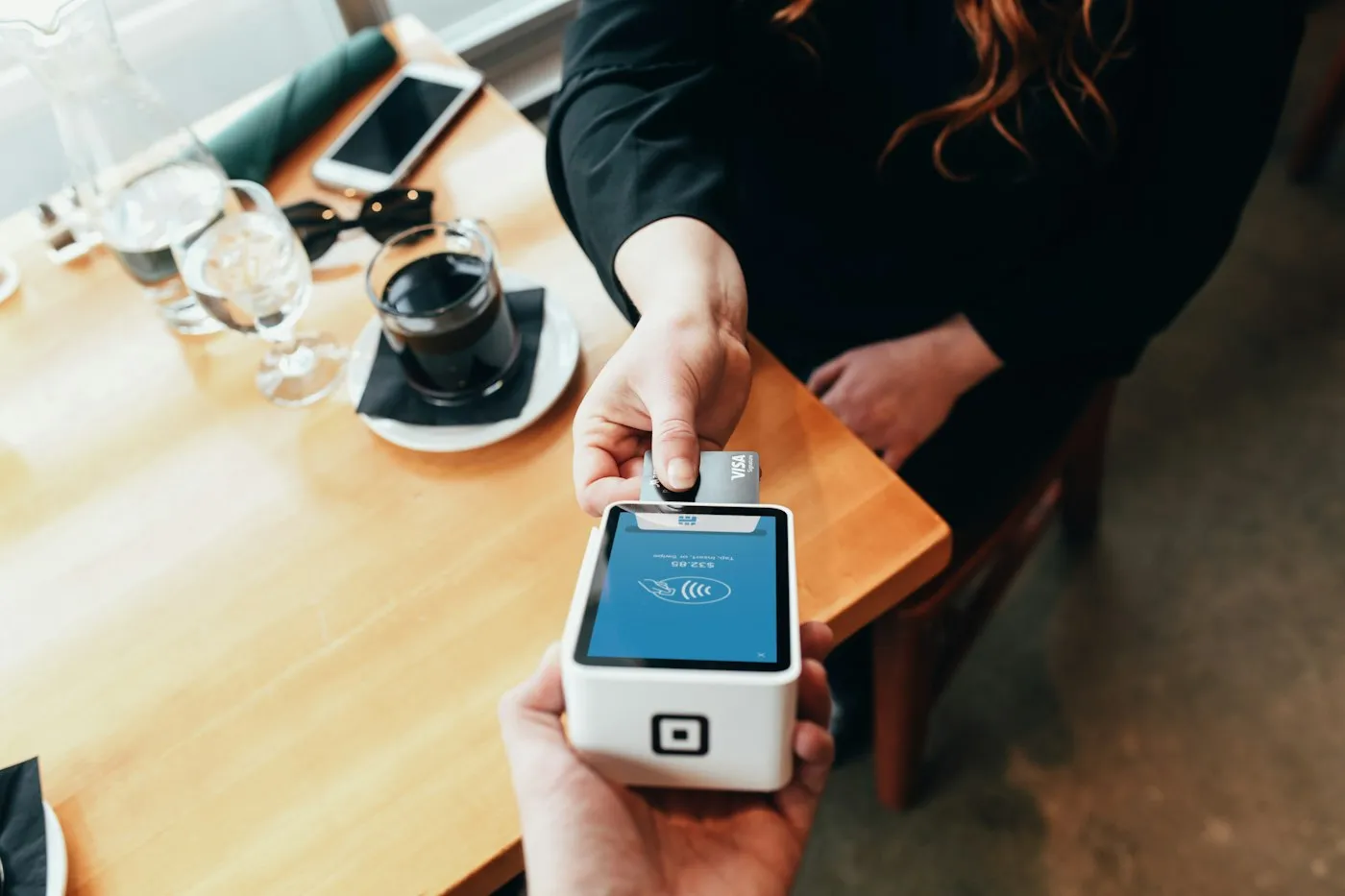
A single card tap at the till is exactly the kind of first-party signal a CDP is built to capture.
The DMP: built for anonymous reach
A Data Management Platform exists for one job: aggregate anonymous audience data, mostly from cookies, device IDs and third-party data providers, and turn it into segments a DSP can target. It does not know who you are. It knows that a pseudonymous identifier visited certain sites, in a certain pattern, and it sells or shares that pattern with buyers.
That design made DMPs the dominant audience tool through most of the 2010s. It is also exactly what makes them fragile now. Cookies expire, often within 30 to 90 days, and third-party cookies themselves are being phased out across browsers, part of the broader shift toward cookieless advertising. A platform built entirely on borrowed, short-lived identifiers has less and less to stand on.
The CDP: built to remember one person
A Customer Data Platform solves a different problem. Instead of aggregating anonymous signals, it pulls together everything a business already knows about an identified customer: website events, CRM records, point-of-sale data, app activity, email engagement, and resolves them into one persistent profile anchored to something real, like an email address or a loyalty number.
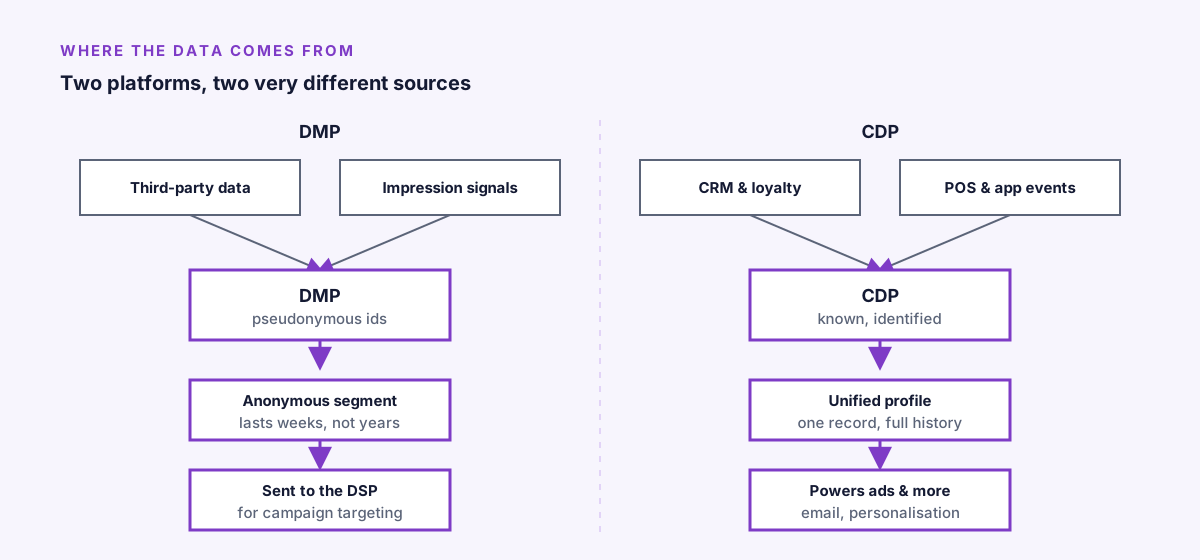
A DMP turns anonymous signals into a short-lived segment. A CDP turns known customer data into a lasting profile that feeds more than just advertising.
That profile is not single-purpose. A CDP typically feeds email marketing, personalisation and customer service as well as advertising, because identity resolution, the work of linking a cookie, a device and an email address to one person, is useful everywhere, not just in a DSP.
A DMP asks “who looks like this anonymous pattern?” A CDP asks “what do we already know about this specific person?”
Same questions, very different answers
Line the two up side by side and the contrast is stark. A DMP works with anonymous, third-party, cookie-based data. A CDP works with identified, first-party data anchored to a real person. A DMP’s output is a segment handed to a DSP or SSP for one campaign. A CDP’s output is a profile that keeps being useful long after that campaign ends, informing the next email, the next in-store offer, the next personalised ad.
Retention tells the sharpest version of the story. Because a DMP depends on cookies, its data is only ever as durable as the cookie itself.
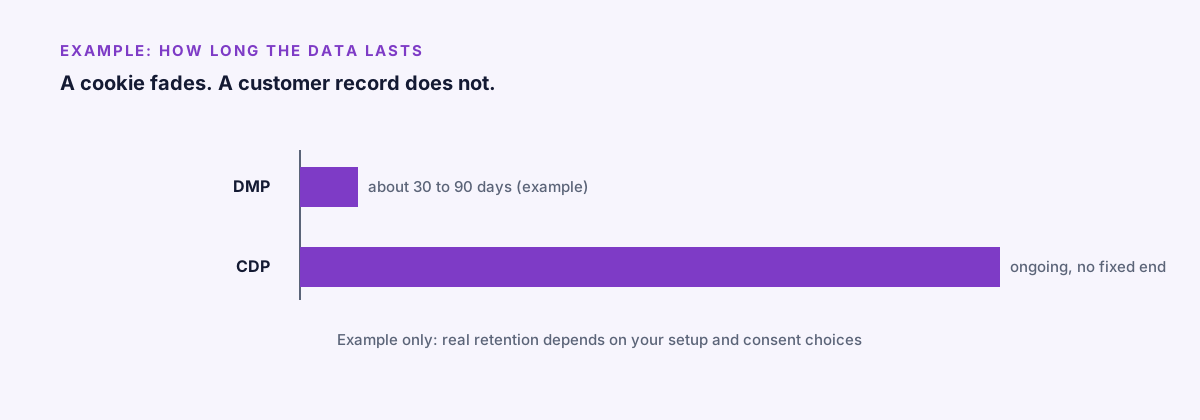
Example only, but the shape holds generally: a DMP’s data expires with the cookie, while a CDP’s record persists as long as the customer relationship does.
A CDP’s record, by contrast, persists as long as the relationship with the customer does. That difference in durability is exactly why so many teams are shifting their center of gravity from DMP to CDP, even while still using a DSP to handle the actual programmatic buying.

Whichever platform supplies the audience, the DSP is still the engine that turns it into bids, creatives and placements.
Neither one replaces a DSP
It is worth repeating because it gets lost often: neither a CDP nor a DMP buys media. The DSP does that. It manages bids, creatives and placements in real-time auctions, and both CDPs and DMPs exist to feed it better audiences to target. The practical difference is simply the quality and durability of what gets fed in. A CDP-derived segment tends to rest on richer, first-party signals that keep working after a browser update. A DMP-derived one increasingly rests on a kind of data that is harder to source reliably every year.
Which one do you actually need?
If your only need is reaching broad, anonymous audiences with third-party data, a DMP is the traditional answer, though building new infrastructure around it today carries real risk given where cookies are headed. If you already have first-party data worth activating, a loyalty programme, a CRM, transaction history, a CDP is the more durable investment, letting you build lookalike and suppression audiences from customers you actually know.
FAQ
Can a business use a CDP and a DMP at the same time?
Yes. Some still blend first-party CDP profiles with third-party DMP segments, though the shift toward cookie-based data is shrinking a DMP’s practical role.
Does a CDP replace a DSP?
No. A CDP resolves and stores customer data. A DSP is what actually bids on inventory and manages creatives and placements in real time.
Why are DMPs losing ground?
Their data depends on cookies that expire within 30 to 90 days, and third-party cookies are being phased out across browsers, so the underlying data gets harder to source every year.
What first-party data can feed a CDP?
Website events, CRM records, point-of-sale data, app activity and email engagement all resolve into one profile anchored to something real, like an email address or a loyalty number.
How Arago helps
Arago’s DSP puts first-party knowledge to work geographically rather than through an uploaded list: a drive-time zone drawn in Map for each store and one line item per store, bidding on the open internet through real-time auctions over OpenRTB, across websites and apps. You can set up allow and block lists per line item, add an IFA (device ID) exclusion list to keep a line item from reaching people you already hold as converted, add your own tracking pixels for double tracking, and let the AI bid on every view based on the rules you define, all without needing a separate enterprise data platform to get started.
Because Arago is free and open, with no contract and no minimum spend, testing whether your first-party data belongs in a CDP is a far smaller decision than it used to be. Explore the DSP or see how creative personalises per viewer in Creative.