
A man sits at a cafe table, newspaper open, reading about a weekend hike in the hills outside town. He has no idea an advertiser is watching, because nobody is. Nobody needs to be. The page itself, an article about trail routes, already says everything an advertiser needs to know about the right moment to mention hiking boots.

Contextual targeting never needs to know who is reading. It only needs to know what they are reading.
That is contextual targeting, one of the oldest ideas in digital advertising, and lately one of the most relevant again, as tracking people across sites gets harder to rely on.
Why match the ad to the page, not the person?
The logic is almost embarrassingly simple: place the ad based on what the surrounding content is about, not on who is reading it. A travel brand on a travel guide. A home improvement retailer on a renovation blog. A local restaurant on a food review site. If someone is reading about hiking gear, they are probably at least a little interested in hiking, and that is reason enough to advertise hiking products in that moment, no profile required. The signal is right there on the page, already doing the targeting for free.

The reader does not need to be identified. The article about the trail already told the advertiser everything relevant.
From crude keywords to something genuinely useful
Early contextual targeting was blunt: a page tagged with the word “car” got automotive ads, whether the article praised a new model or reported a crash. That approach produced some famously bad, occasionally brand-unsafe placements, and it is part of why contextual targeting earned a reputation for being a step down from more “precise” behavioral methods, a reputation that has aged badly as the technology underneath it quietly improved.
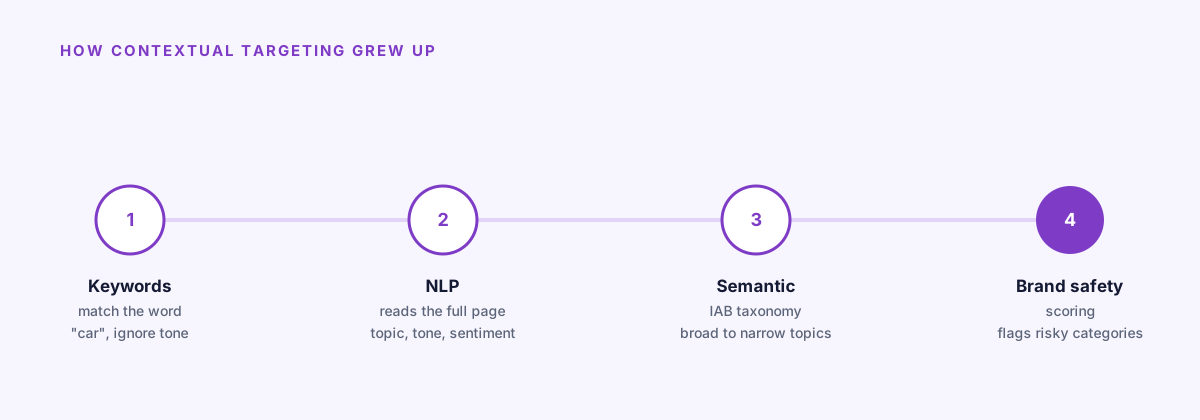
Each step adds a layer of actual understanding, from matching a word to reading the page the way a person would.
Modern contextual technology is a different animal. Natural language processing reads full-page content for topic, tone, and sentiment, not isolated words. Semantic classification sorts pages into category hierarchies, the IAB content taxonomy being the common one, so an advertiser can target a broad vertical or a narrow sub-topic. Brand safety scoring flags categories like violence or misinformation independently of who happens to be reading. Attention prediction models even estimate how engaged a typical reader of a given page layout tends to be.
What it gives up, and what it gets in return
Behavioral targeting builds a profile of a person across sessions and sites, then serves ads based on inferred interests. Done with rich signal, it can be precise, but it depends on persistent identifiers and carries real privacy weight.
Contextual targeting sidesteps all of that by working at the page level instead of the user level.
A contextual match does not ask who you are. It only asks what is in front of you right now.
That gives it three practical advantages: it is inherently privacy-compliant, since no personal data is collected or stored, it works whether or not someone has accepted tracking, and it scales across every piece of inventory rather than excluding anyone without a known profile.
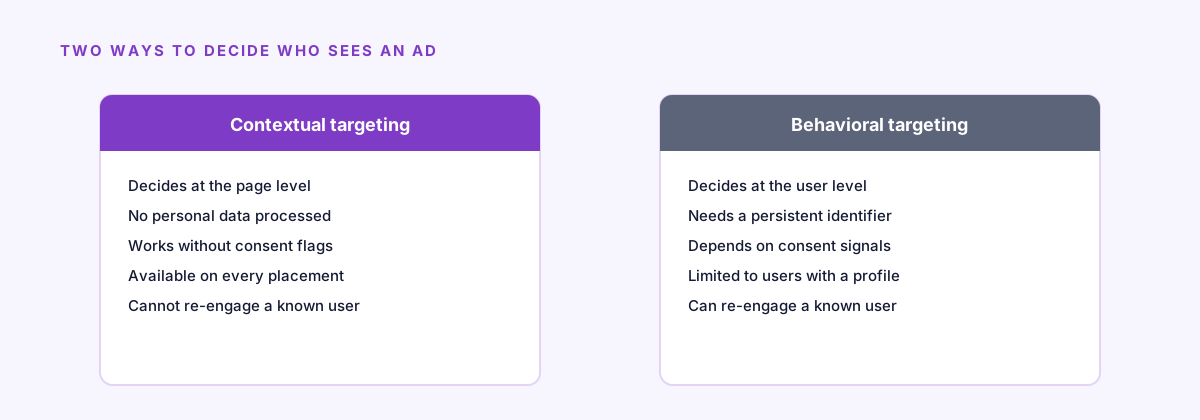
Neither approach is strictly better. They answer different questions: what is this page about, versus who is this person.
Where does contextual targeting perform best?
A few scenarios play to contextual targeting’s strengths. Upper-funnel awareness campaigns benefit from reaching relevant audiences at scale without needing a built-up profile. New product or brand launches, with no first-party audience to draw on yet, get a privacy-safe way to start cold. Regulated categories like health, finance, and pharmaceuticals often prefer it precisely because it avoids handling sensitive personal data. And publishers with a strong editorial identity, cooking, automotive, parenting, bring a readership whose interests are, by the nature of the content, already contextually defined.
How it plugs into programmatic buying
In practice, contextual signals reach a DSP through deal IDs, publisher-provided segments, or page categorization computed in real time at the bid request level. Some supply-side platforms enrich the bid request with that contextual metadata directly, letting demand-side platforms apply contextual filters at scale without touching user-level data at all. Advertisers who want both worlds can layer them, running contextual campaigns to capture new audiences while a separate line reactivates known customers using first-party data. The two approaches end up complementing each other more often than competing.
FAQ
Is contextual targeting still relevant without cookies?
Yes, and increasingly more so. Contextual targeting never depended on cookies or persistent identifiers, so it keeps working as cookieless browsing becomes the norm.
Does contextual targeting still rely on simple keyword matching?
Not anymore. Modern contextual technology uses natural language processing and semantic classification to read a full page the way a person would, rather than matching isolated words.
Can contextual and behavioral targeting be used together?
Yes. Many advertisers run contextual campaigns to reach new audiences while a separate line reactivates known customers with first-party data, since the two approaches tend to complement each other.
Is contextual targeting less precise than behavioral targeting?
Not inherently. Contextual targeting answers a different question, what the page is about rather than who the person is, and modern classification can be just as accurate at matching intent.
How Arago helps
Arago’s targeting lets a local retailer reach relevant audiences across the open internet, buying in real time over OpenRTB on websites and apps, without depending on user-level tracking. For a business entering a new market or launching a seasonal push, that means immediate reach with privacy compliance built in from the start, combined with the rest of Arago’s targeting: allow and block lists per line item, devices, languages, frequency capping, and drive-time zones around each store from Map. No contract, no minimum spend, you only fund the campaigns you run.