
It is 7:52 in the morning. Someone pours coffee, opens a weather app to check whether they need an umbrella, and closes it twelve seconds later. In that window, two pieces of software that have never exchanged a human sentence just negotiated the sale of a single ad impression: who gets to show one, and for how much.
One of those programs worked for the weather app. The other worked for a shoe brand that wanted exactly this kind of early-morning, umbrella-checking visitor. The first is a supply-side platform. The second is a demand-side platform. Most explanations of programmatic advertising mention both in the same breath, DSP vs SSP, as if they were a matched pair of acronyms. They are closer to two people on opposite sides of a negotiating table, each one paid by a different client, each one trying to win.
Two sides of the same marketplace
Every digital ad impression involves at least two parties. Someone wants to show an ad (the advertiser). Someone else has space to show it (the publisher). Programmatic advertising gave each side its own dedicated software to represent its interests in an auction that happens automatically, thousands of times a second, across the internet.

Every page load is itself a tiny marketplace. Before the images finish rendering, a seller and a buyer have already found each other.
A DSP (demand-side platform) is the advertiser’s tool. It looks at the impressions on offer, decides how much each one is worth, and manages how a campaign gets delivered and improved over time. A SSP (supply-side platform) is the publisher’s tool. It packages the inventory a website or app has available, shows it to potential buyers, and tries to get the best possible price for every single impression.
The two platforms never talk directly. They meet through ad exchanges, marketplaces where bid requests sent by SSPs are matched with bid responses sent by DSPs, and where the winning price is decided in real time.
Meet the two platforms, side by side
Laid out next to each other, the contrast is easier to see than any paragraph can make it. Same transaction, same millisecond, completely different job description.
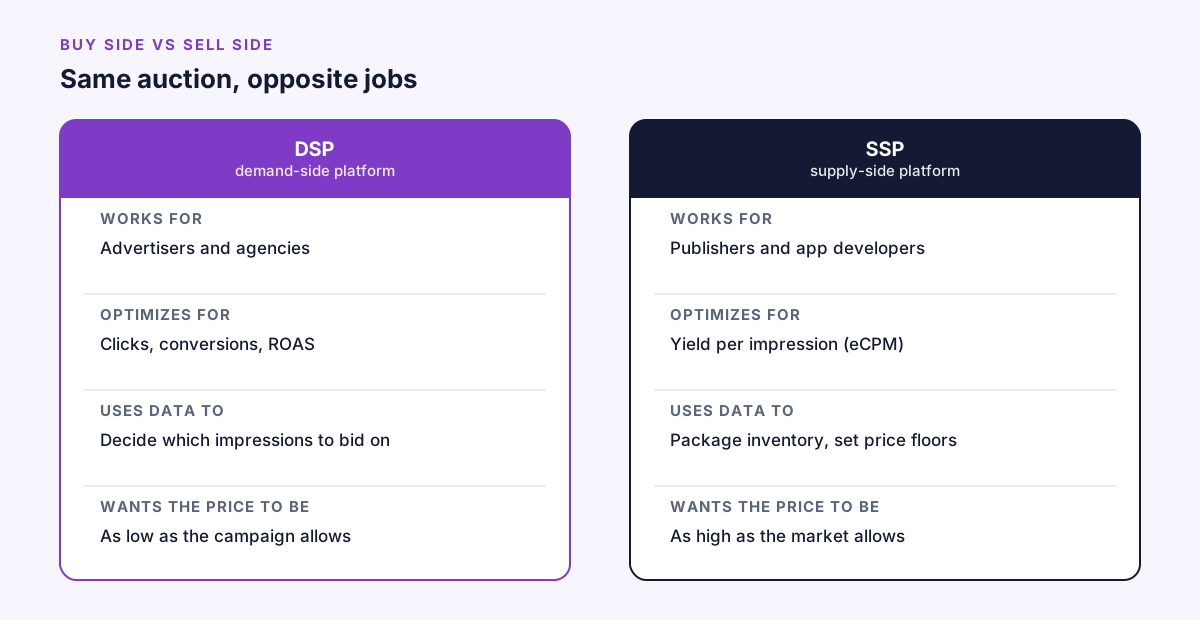
The DSP and the SSP sit in the same auction but answer to different people, which shapes everything else they do.
A quick way to remember it: the DSP wants to spend the advertiser’s budget well. The SSP wants to sell the publisher’s inventory well. Both of those goals can be true for the same impression at the same time, which is exactly what makes an auction work.
Key differences, in practice
Who they serve
The most basic difference is the direction of loyalty. A DSP exists to help advertisers spend a budget efficiently: reach the right audience, at the right moment, at a price that still leaves room for profit. An SSP exists to help publishers earn as much as they reasonably can from the space they have, by attracting enough buyers that competition does the work of pushing prices up.
What they optimize for
A DSP optimizes toward advertiser outcomes: impressions that turn into clicks, clicks that turn into conversions, and a return on ad spend that justifies the budget. It may use automated bidding to work out which bid requests are worth winning and which ones are not worth the price being asked.
An SSP optimizes toward publisher yield, usually measured as revenue per thousand impressions (RPM or eCPM). It routes each impression to whichever demand source is paying the most for it that moment, and it tests floor prices continuously so that nothing is sold for less than the market would actually bear.

The DSP side of the table: a team reading campaign numbers, the same kind of reporting a DSP produces while a campaign is live.
How they handle data
A DSP draws on advertiser data: CRM lists, pixel audiences, third-party segments, to judge which impressions matter for a given campaign. It bids more aggressively on impressions that match the target audience, and less, or not at all, on the ones that do not.
An SSP draws on publisher data: page context, user signals, and historical demand patterns, to package impressions attractively and set realistic price expectations. Some SSPs also enrich a bid request with audience data of their own, to help buyers bid with better information.
Pricing logic
You cannot ask one piece of software to represent both sides of a negotiation at once. That is the whole reason a DSP and an SSP exist as separate things.
From the DSP’s side, the goal is to win the impressions most likely to produce results, for the lowest cost that still wins them. It manages bid shading, frequency capping, and pacing so a budget does not disappear on impressions that were never going to perform.
From the SSP’s side, the goal is to make sure nothing is given away under its market value. It uses floor prices, header bidding competition between multiple buyers, and demand prioritization to push the final price as high as the auction will support.
How they interact in a single transaction
Strip away the acronyms and a single impression being sold looks like a short, five-step relay race, run in well under a second.
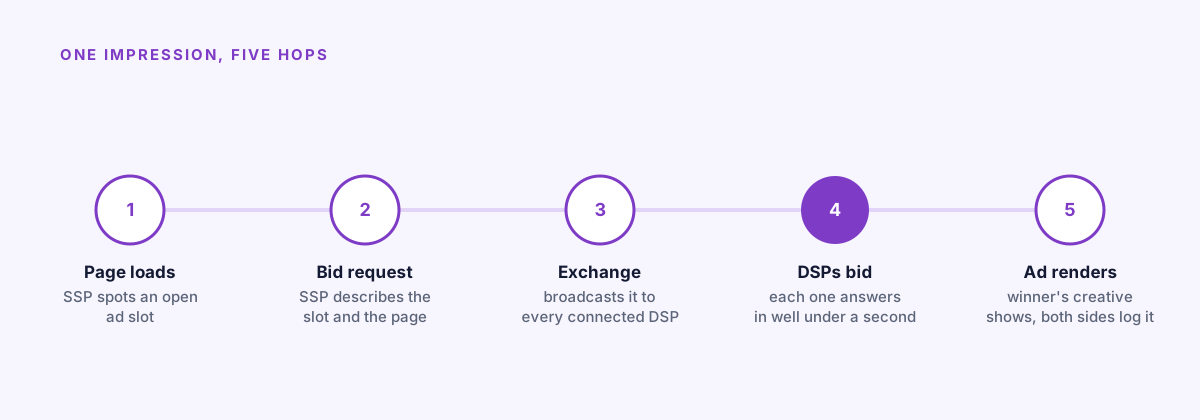
From an empty ad slot to a rendered ad, in five hops. Every one of these steps is automated, and every one is logged for reporting afterward.
- A user loads a publisher’s page. The SSP notices an available ad slot.
- The SSP builds a bid request describing the slot, the page, and whatever audience data is attached.
- That request is broadcast to every DSP connected to the ad exchange handling the sale.
- Each DSP checks the request against its active campaigns and answers with a bid, or with silence, inside a very tight window.
- The exchange picks the winning bid and tells the SSP who won.
- The SSP hands the winning creative to the publisher’s ad server, which actually renders it on the page.
- Both platforms log the transaction, for billing on one side and for optimization on the other.
If you want the buyer’s half of that story told in more detail, what a DSP actually does and how real-time bidding settles the price are worth a closer look. The publisher’s half is covered in what an SSP actually does.
Where the lines blur
In practice, the split between DSPs and SSPs has become less sharp than this article might suggest. Some large platforms operate both sides at once, the so-called walled gardens and large ad tech holding companies. Header bidding wrappers let a publisher call several SSPs at the same time, turning the sale into a more open competition rather than a single pipe. And some SSPs now offer tools that look a lot like DSP features, such as audience targeting for inventory sold directly rather than through an open auction.
The underlying logic still holds, though. Buy-side technology optimizes for the buyer. Sell-side technology optimizes for the seller. And the exchange sitting between them decides who wins each impression, instant by instant.
Why local advertisers should care
For a local retail advertiser, none of this is abstract. The DSP and SSP relationship decides what inventory is actually available to buy, at what price, and with how much visibility into where the money goes. A DSP with strong, direct connections to quality SSPs can reach premium placements, news sites, streaming services, local media, at a competitive price. Thin or indirect supply connections mean fewer real options, more intermediaries taking a cut, and often a higher CPM for a worse placement.
That is the practical reason this distinction is worth understanding even if you never touch either platform directly. The quality of your DSP’s supply relationships shows up, eventually, as the quality of the inventory your ads actually land on.
How Arago helps
Arago runs as a self-serve DSP, which puts it firmly on the buy side, working for local retail advertisers rather than for publishers. It connects to premium SSPs and exchanges on the open internet, buying through real-time bidding over OpenRTB on both websites and mobile apps, which gives local retailers the same kind of programmatic access that larger national brands use, in a workflow built for a local-market budget rather than a national one.
Because Arago is free and open (DSP, Map and Creative included, no contract, no minimum spend), you only ever fund the campaigns themselves, never the platform that runs them. See pricing for the detail.
FAQ
Is a DSP better than an SSP?
Neither is “better,” they serve different customers. A DSP is built for the advertiser buying impressions. An SSP is built for the publisher selling them. Asking which one is better is a bit like asking whether a buyer’s agent is better than a seller’s agent in a property sale: it depends entirely on which side you are on.
Can one company run both a DSP and an SSP?
Yes, and several large ad tech companies do exactly that. It raises fair questions about transparency, since the same company can end up representing both the buyer and the seller in a single transaction, but it is technically common and not against any rule of the ecosystem.
Does a local retailer need to deal with SSPs directly?
No. A self-serve DSP handles the SSP and exchange relationships on your behalf. As an advertiser you set budgets, targeting, and creative, and the DSP does the work of finding and bidding on the right impressions across whichever SSPs carry them.
How fast does a DSP and SSP transaction actually happen?
The whole exchange, from a publisher’s page requesting an ad to a creative actually rendering, typically happens within the time a page takes to load, well under a second from the moment the ad slot is detected. Nothing about it is visible to the person browsing the page.
What happens if no DSP bids on an impression?
The SSP falls back to its next best option: a lower-priority demand source, a house ad, or simply an empty slot. This is exactly why publishers care about connecting their SSP to as many quality demand sources as possible, an unsold impression earns nothing at all.