Someone opens a local news site on their phone while waiting for the bus. Before the page has even finished loading, an ad for a bakery three streets away is already on screen. Nobody at that bakery picked this exact reader, this exact moment, or this exact page. A piece of software did, and it made the call in less time than it takes to blink.
That software is a demand-side platform, or DSP. So what is a DSP, exactly? It is the engine that lets an advertiser buy ad space across thousands of websites and apps from a single screen, instead of calling each publisher one by one.
What a DSP actually does
Strip away the acronyms and a DSP does one thing, over and over, at enormous speed: it looks at an ad space that just became available, decides whether it is worth buying, and if so, how much to pay for it.
Each of those ad spaces is called an impression, one single view of one single ad slot, on one single page, for one single person. A DSP does not buy “a campaign” the way a billboard company sells a wall for a month. It buys impressions, one at a time, thousands or millions of times a day, each one judged on its own.
Before DSPs existed, buying display ads meant an advertiser emailing an insertion order to a publisher’s sales team, negotiating a price, and waiting for a line to go live. That worked when a brand wanted to appear on a handful of big sites. It did not work for a local business that wanted to reach people near one specific shop, across the hundreds of sites and apps those people might actually open that day.
Where a DSP sits in the chain
A DSP sits on the buying side of what the industry calls programmatic advertising. On the other side sits the publisher, usually represented by a supply-side platform (SSP) or an ad exchange, which is where the publisher’s available inventory gets listed for sale.
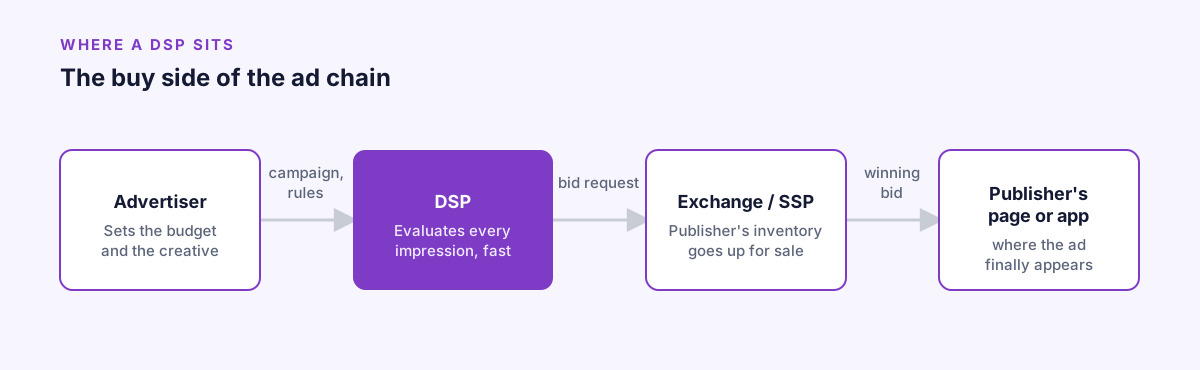
The diagram above shows the shape of it. The advertiser sets a budget and supplies the creative. The DSP evaluates each opportunity to show that creative. The exchange or SSP is where the publisher’s inventory is listed. The page or app is where the ad finally renders, if the DSP’s bid wins.
Everything in that chain happens before a page finishes loading. A DSP’s job is to compress a decision that used to take days (which publisher, what price, which audience) into a single automatic step that happens once per impression.
What happens in under 100 milliseconds
Here is the sequence, roughly, from the moment a page opens to the moment an ad shows up:
- A user opens a page or an app, and one of its ad slots needs filling.
- The publisher’s side sends out a bid request: the format, the context, general location, and device, never a name.
- Every connected DSP looks at that request and decides, in a fraction of a second, whether it matches what one of its advertisers is looking for.
- If it does, the DSP responds with a bid. If not, it passes, and no money changes hands.
- The highest valid bid wins, and that advertiser’s ad is the one that shows up.
All five of those steps happen in the time it takes the page to render. For a deeper look at the mechanics, including why this particular kind of auction became the industry standard, see our piece on real-time bidding.
What a DSP weighs before it bids
A DSP is not guessing. Every bid decision draws on a handful of concrete inputs, collected and scored in the time between the bid request arriving and the bid going out.
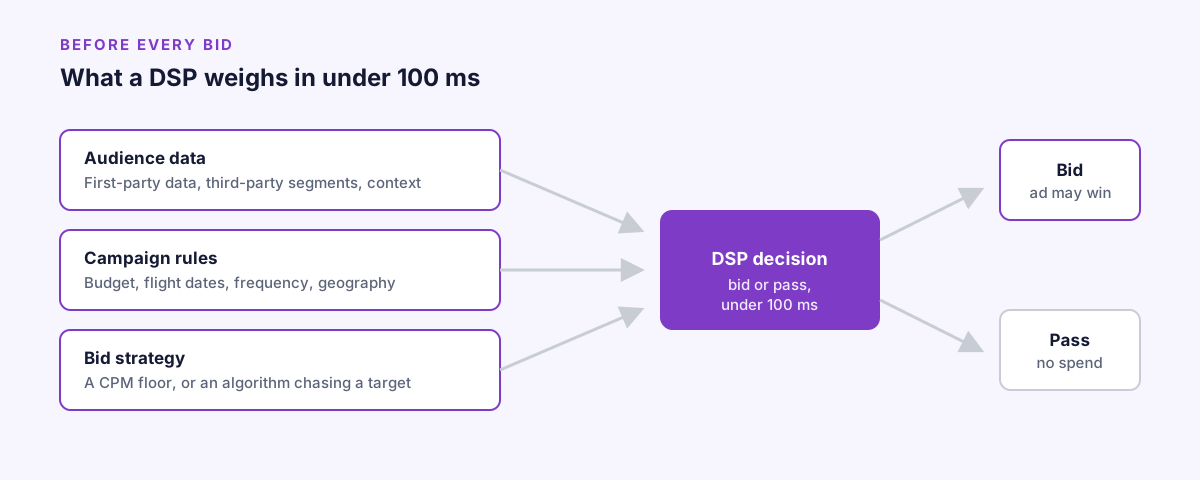
- Audience data: first-party data the advertiser already has, third-party segments, or simply the context of the page itself.
- Campaign rules: the budget that is left, the dates the campaign is meant to run, how often the same person should see the ad, and where that person needs to be.
- Bid strategy: a fixed price floor the advertiser is willing to pay, or an algorithm chasing a target outcome like a cost per click.
A DSP does not ask “is this a good audience in general.” It asks “is this one view, right now, worth this much money.” That question gets asked and answered millions of times a day.
If the numbers line up, the DSP bids. If they do not, it passes silently, and the advertiser never sees a cost for that impression.
What a DSP gives advertisers
Centralized control
Before DSPs, running a multi-publisher campaign meant juggling several separate relationships, each with its own reporting format, its own minimum spend, and its own timeline. A DSP puts budgets, creative, and performance data for every placement behind one login.

Planning a campaign used to mean one conversation per publisher. A DSP turns it into one conversation, period.
Audience targeting
A DSP can reach a specific kind of person, wherever that person happens to be browsing, rather than reaching “whoever reads this particular website.” That might mean people inside a drive-time radius of a store, or people who visited a product page recently, depending on what data the advertiser connects.
Real-time optimization
Because every impression is judged individually, a DSP can shift spend while a campaign is still running. If a certain time of day, device type, or site category is converting better than another, the system can lean into it immediately instead of waiting for a weekly report.
Transparency and reporting
Every bid, every impression, and every click gets logged. An advertiser can see exactly where an ad appeared, what it cost, and whether it led anywhere, a level of detail that a printed insertion order never offered.
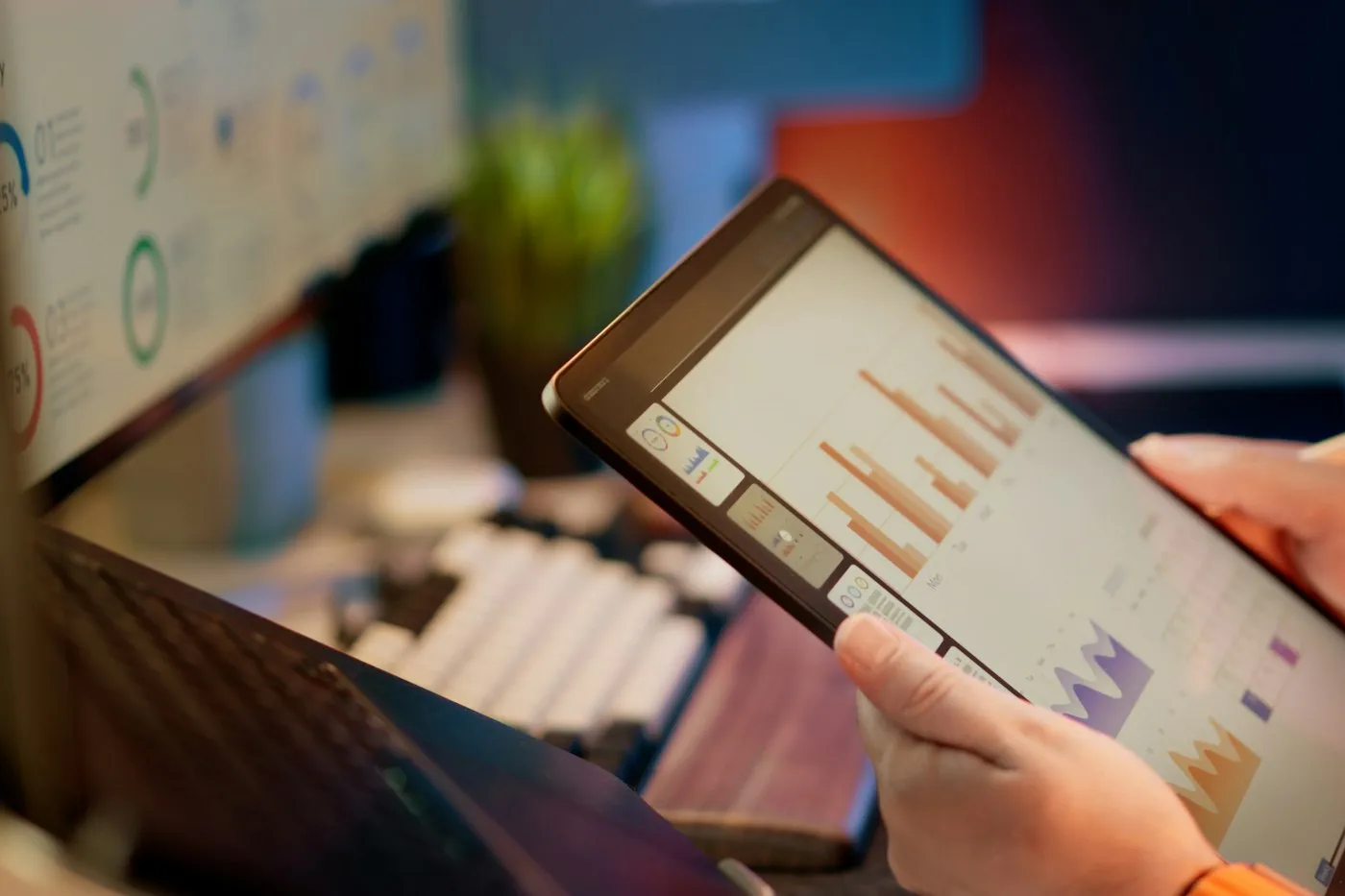
Every impression leaves a trace. A DSP turns that trace into a dashboard an advertiser can actually read.
Types of DSPs
Not every DSP is built the same way, and the differences matter when choosing one.
- Self-serve vs. managed: a self-serve DSP is one the advertiser operates directly. A managed DSP has the platform’s own team running campaigns on the client’s behalf, usually for a larger fee.
- Channel specialization: some DSPs focus narrowly on display and video. Others add connected TV, digital out-of-home, audio, or combine several channels in one interface.
- Vertical focus: a handful of DSPs build specifically for one industry (retail, travel, automotive) and shape their workflow and data options around that industry’s needs.
A local retailer evaluating DSPs usually cares less about channel breadth for its own sake and more about whether the platform’s workflow matches the scale of running one store, or several hundred.
What to look for in a DSP
A few questions tend to separate a good fit from a bad one:
- Does it buy on the open internet, or only inside a closed, curated pool of its own choosing?
- Can it connect first-party data the advertiser already has, like a customer list or a store locator feed?
- Does its reporting break results down by the unit that actually matters, store, city, or campaign, rather than one blended number?
- Is there a minimum spend or a platform fee sitting on top of the media cost?
- Can one person manage ten line items as easily as managing one, or does scale mean more manual work?
That last question matters more than it sounds. A DSP built for a handful of large national campaigns often buckles, workflow-wise, the moment someone tries to run a hundred small local ones instead.
FAQ
Is a DSP the same thing as an ad network?
No. An ad network buys inventory in bulk and resells it, often bundling unsold space from several publishers. A DSP buys impression by impression, in a live auction, typically across many exchanges and SSPs at once, rather than reselling a fixed pool.
Do I need a separate DSP for display, video, and connected TV?
Not necessarily. Many DSPs support multiple formats from one interface, though the depth of support for each channel varies a lot between platforms. Check specifically for the formats a campaign actually needs rather than assuming full support everywhere.
How much does a DSP cost to use?
It depends on the platform. Some charge a percentage of media spend, some charge a flat platform fee, and some require a minimum monthly budget before an advertiser can start. These costs sit on top of whatever is actually spent buying impressions.
Can a small local business use a DSP, or is it only for big brands?
Self-serve DSPs with no minimum spend are usable by a single-location business. The real question is whether the platform’s workflow is built for that scale, or whether it assumes every advertiser is managing a handful of large national campaigns.
What happens if my DSP’s bid loses the auction?
Nothing costs money. A lost bid means the impression goes to the next highest eligible bidder, and the advertiser who lost pays nothing for that particular view. The DSP simply evaluates the next impression that comes along.
How Arago helps
Arago is a self-serve DSP built for local retail, and it is free: no contract, no minimum spend, no platform fee sitting on top of the media. It buys on the open internet through real-time bidding over OpenRTB, across websites and mobile apps, and it bids on every single view.
What makes it fit a local business specifically is multi-local structure: every location gets its own line item, with its own area, its own budget, and its own ad, so a brand running three cities or a retailer running a hundred and twenty stores works from the same simple setup. Zones are drawn in real driving time with Map, not a plain radius. Allow and block lists, frequency capping, and third-party tracking pixels let an advertiser check the DSP’s own numbers against theirs. And since Creative launches with the DSP at no extra cost, an advertiser is never stuck choosing between a plain banner and a design fee. See pricing for the full list of what is included from the first campaign.