You load a recipe site to check how long to roast a chicken. The page takes about a second to finish rendering. In that second, your browser was the venue for an auction you never saw: a piece of software decided your attention was worth bidding on, another piece of software decided how much to offer, and a third settled who won. Nobody picked up a phone. Nobody signed anything. The whole transaction happened and finished before the recipe had fully loaded.
That is programmatic advertising: the automated buying and selling of digital ad space, using software and real-time auctions instead of people negotiating placements one at a time. It is now the dominant way digital media gets bought, worldwide, and it is worth understanding even if you never plan to touch the controls yourself.
How programmatic differs from traditional buying
In traditional media buying, an advertiser’s agency calls a publisher’s sales team, negotiates a rate, and signs an insertion order specifying which placements will run, for how long, and at what cost. It works, but it is slow, it takes real headcount on both sides, and it does not scale well across dozens of publishers at once.
Programmatic buying replaces most of that with software. An advertiser loads a campaign into a DSP (a demand-side platform), sets targeting and a budget, and the platform automatically bids on individual impressions, across thousands of publishers, that match those parameters. The result is faster execution, far more granular audience targeting, and performance feedback that arrives in near real time instead of at the end of a flight.
Nobody negotiates an insertion order for a single impression. The whole point of programmatic is that nobody has to.
The programmatic ecosystem
Several types of platforms make up the programmatic stack, each one talking to the next.
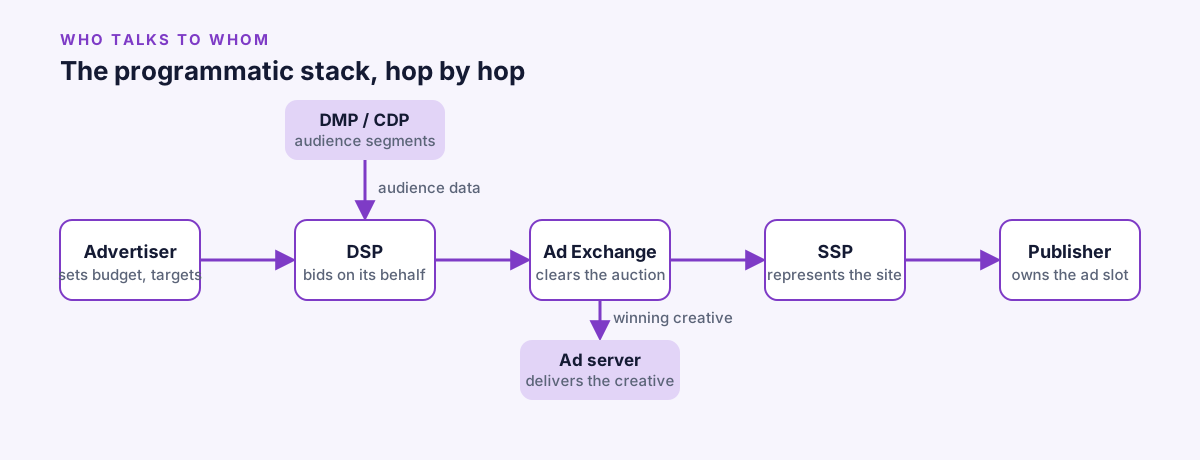
Five hops from budget to banner. A DMP or CDP feeds the DSP with audience data, and an ad server actually delivers the winning creative once the auction closes.
- DSPs (demand-side platforms): used by advertisers and agencies to buy inventory. See what a DSP actually does.
- SSPs (supply-side platforms): used by publishers to sell inventory. See what an SSP actually does.
- Ad exchanges: neutral marketplaces where DSP bids meet SSP supply.
- DMPs and CDPs: data platforms that supply audience segments to sharpen targeting.
- Ad servers: the systems that traffic and deliver the winning creative to the end user.
These pieces talk to each other through standardized protocols, mainly OpenRTB, which defines how a bid request and a bid response are structured so that any DSP can understand any SSP’s offer.
None of this is abstract. A bid request, a bid response, and a rendered ad all pass through real hardware, fast enough that the person loading the page never notices.
Four ways a transaction can happen
Not all programmatic buying happens through an open, anyone-can-bid auction. There are four common transaction types, running on a spectrum from fully open to fully negotiated.
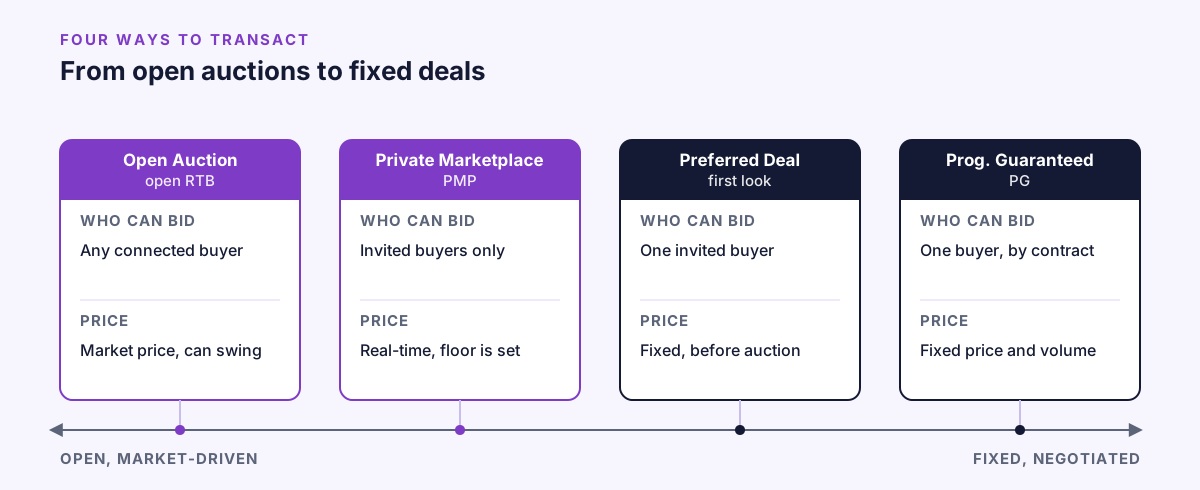
The same inventory can be sold four different ways. Open auctions give the best price discovery. Guaranteed deals give the most certainty. Most advertisers use a mix.
Open auction (open RTB)
The most common form, built on real-time bidding. The publisher’s SSP sends a bid request to every connected DSP. Any eligible buyer can bid. The impression goes to the highest qualifying bid, and prices are market-driven, which means they can move significantly depending on demand.
Private marketplace (PMP)
A publisher invites a select group of buyers into a private auction. The impression is still sold through real-time bidding, but access is restricted. PMPs are typically used for premium inventory: above-the-fold placements, high-traffic news sites, streaming pre-roll.
Preferred deals
A one-to-one arrangement where an advertiser gets the right of first look at an impression, at a fixed price, before it ever reaches the open auction. If the advertiser passes, the impression moves on to the next buyer in line.
Programmatic guaranteed (PG)
A direct deal between a publisher and an advertiser, negotiated upfront with a fixed price and a volume commitment, but executed and delivered programmatically. The advertiser gets guaranteed access to specific inventory. The publisher gets guaranteed revenue. Reporting and delivery are still automated.
Targeting: who sees the ad, not just where it runs
One of programmatic’s biggest advantages over traditional buying is the ability to define who should see an ad, rather than only where the ad will appear. Common targeting parameters include:
- Audience segments: behavioral, demographic, or interest-based groups built from data.
- Contextual: targeting based on the content of the page, without relying on identifying the individual user.
- Geographic: country, region, city, postal code, or a radius around a physical location.
- Device and environment: mobile versus desktop, operating system, browser, app versus web.
- Time of day and day of week: dayparting, to align delivery with when an audience is actually receptive.
- Retargeting: reaching people who have already interacted with the advertiser’s website or app.
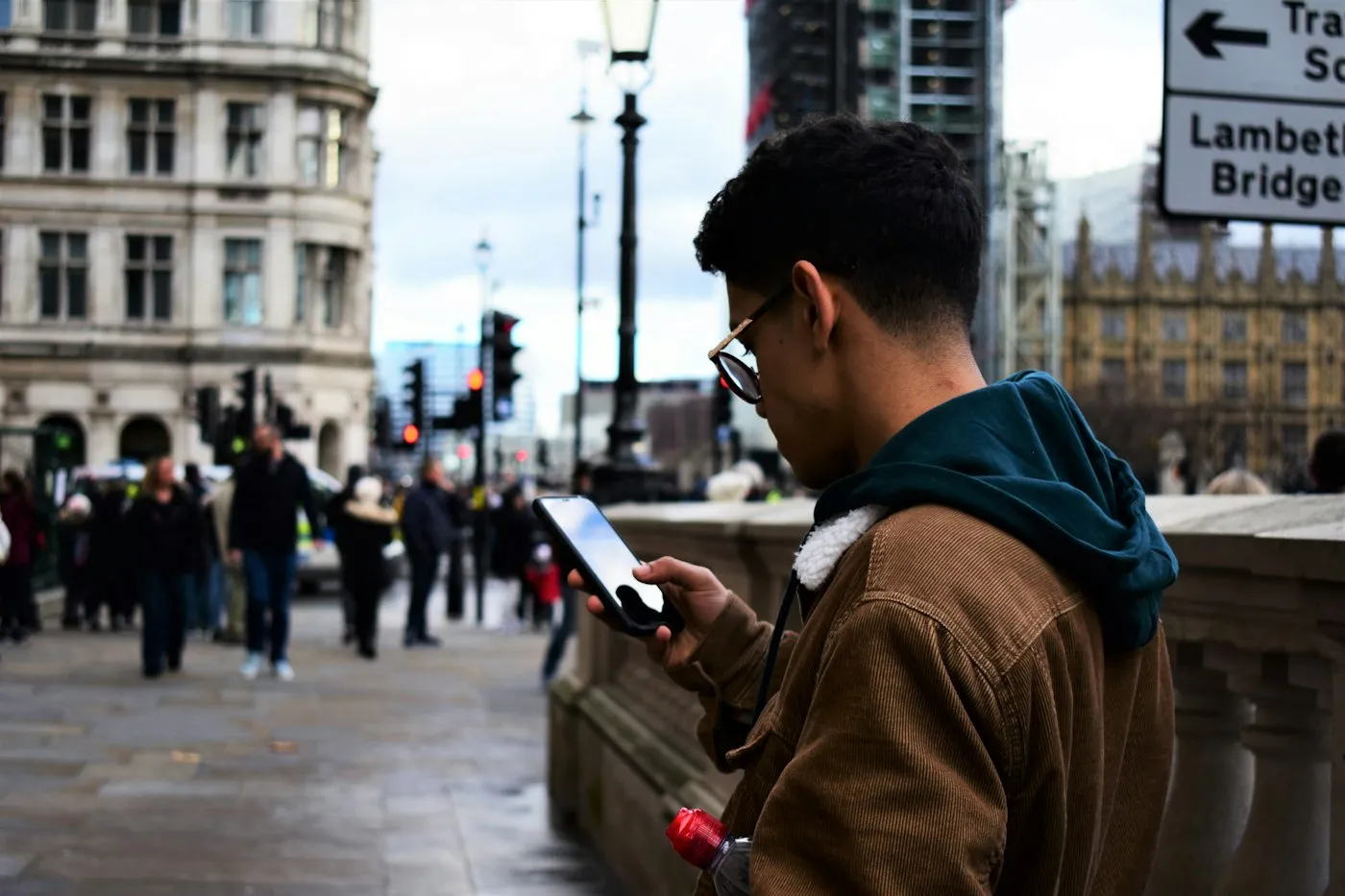
Targeting is not about reaching the crowd. It is about choosing which person inside it is actually worth a bid.
Measurement and attribution
Programmatic campaigns produce rich, event-level data: every bid, impression, click, and conversion gets logged. That data feeds attribution models, which try to assign credit for a sale or an action to the ad touchpoints that actually contributed to it.
Common attribution models include last-click (all the credit goes to the final ad clicked before conversion), first-click (credit to the very first touchpoint), linear (credit spread evenly across every touchpoint), and data-driven (credit weighted by an algorithm’s estimate of each touchpoint’s contribution).
Picture a shopper who sees a display ad on Monday, a video ad on Wednesday, and finally clicks a retargeting ad on Friday before buying. Last-click would give Friday’s ad all the credit and treat Monday and Wednesday as if they never happened. Data-driven attribution would try to weigh all three, which is closer to the truth but harder to explain in a single sentence to someone who just wants to know what worked.
Challenges worth knowing about
Programmatic advertising is powerful, but it is not without friction:
- Ad fraud: automated traffic (bots) can generate fake impressions and inflate delivery numbers.
- Brand safety: without the right controls, an ad can end up next to content that conflicts with an advertiser’s values.
- Viewability: not every served impression is actually seen by a real person.
- Data privacy: cookie deprecation and privacy regulation are changing how audience data can be collected and used.
- Supply chain transparency: knowing exactly which intermediaries touched an impression, and what each one charged, takes active auditing.
How Arago helps
Arago brings programmatic advertising to local retail advertisers in a self-serve format built for their scale rather than a national brand’s. Its DSP buys on the open internet via real-time bidding over OpenRTB, across websites and mobile apps, and it checks your rules (zone, allowed sites, budget) before every bid, in roughly the time it takes a page to finish loading. Controls include allow and block lists per line item, your own tracking pixels alongside Arago’s, viewability measured to the IAB Open Measurement SDK and the MRC standard, and frequency capping, so the targeting parameters above are not just theoretical.
Multi-local campaigns get their own structure: every location is its own line item, with its own budget and its own ad, which you can add by the hundred, paste from a spreadsheet, or import as a zone file. Map lets you target the area customers actually drive from, in real driving time, rather than a flat radius. Creative adds interactive formats, personalized per viewer down to the nearest store, at no extra fee per ad. See pricing for what, exactly, is free.
FAQ
Is programmatic advertising the same as display advertising?
No. Display is a format (banner-style ads on a page). Programmatic is a buying method. You can buy display, video, connected TV, or digital out-of-home space programmatically, the auction mechanics stay roughly the same regardless of format.
Do I need a huge budget to use programmatic advertising?
Not inherently. The technology itself scales down as well as up, a self-serve DSP with no minimum spend lets a local advertiser buy the same open-internet inventory a national brand buys, just at a smaller scale.
How is programmatic different from buying through Google or Meta directly?
Google and Meta’s own ad platforms are closed systems that mostly sell their own inventory. A DSP buys across the open internet, meaning thousands of independent websites and apps, through exchanges and SSPs, rather than within one company’s walled garden.
Is programmatic advertising private or does it track me personally?
Targeting can be contextual (based on the page, not the person) or audience-based (based on data segments). Regulation and cookie deprecation have been pushing the industry toward more contextual and privacy-safe targeting methods, and away from tracking individuals across the web.
What is the smallest unit being sold in programmatic advertising?
A single ad impression, one ad shown to one visitor at one moment. That is the level at which bidding, pricing, and reporting all happen, which is what allows targeting and budgets to be this precise.