
A recipe site has a rectangle of empty space above the ingredients list. It has had that rectangle for years. What changed is what fills it: not a salesperson’s phone call, but an auction that runs and clears before the page has finished loading.
The software running that auction, on the publisher’s behalf, is a supply-side platform, or SSP. So what is an SSP, exactly? If a demand-side platform (DSP) represents the advertiser, an SSP represents the other side of the deal: the site or app that actually has space to sell.
The problem an SSP solves
Before SSPs existed, a publisher had two real options for selling ad space. Sell it directly, through a sales team calling advertisers one at a time, or hand the leftovers to an ad network that bundled unsold inventory across many sites and sold it cheap.
Both had the same weakness: only a handful of buyers ever saw any given impression. A direct sales team cannot call a thousand advertisers before a page loads. An ad network solves that by bundling, but bundling means low prices, because nobody is competing hard for any specific impression.
An SSP fixes this by doing the opposite of bundling. It takes one single impression and shows it to many buyers at once, letting them compete for it in real time.
Where an SSP sits in the chain
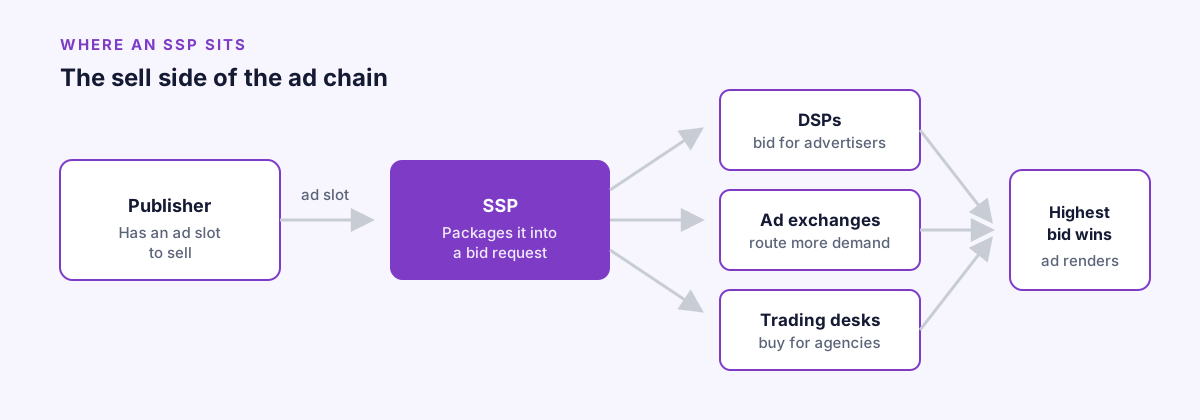
One impression, offered to many buyers at once. The highest valid bid wins it.
The publisher owns the ad slot. The SSP packages information about that slot, its size, its context, and whatever audience data is attached, into something called a bid request. That request goes out simultaneously to connected DSPs, ad exchanges, and trading desks. Each of them can respond with a bid, and the SSP picks the highest one that clears the publisher’s rules.
An SSP is not selling to one advertiser. It is running an auction where every connected buyer gets to compete for the exact same impression, at the exact same moment.
This is also why a publisher’s inventory can end up inside the same campaign that a completely unrelated advertiser is running through a DSP somewhere else. The SSP is the meeting point.
What a publisher actually configures
Inventory and floor prices
A publisher sets up its ad slots in the SSP: sizes, formats, and which placements are even for sale. On top of that sits a floor price, the lowest CPM the publisher will accept for a given slot, which can vary by audience, by device, or by time of day.

Publishers used to sell the space next to the content. Today the content, and the inventory next to it, both live online, but the business is still built on readers showing up.
Yield management
An SSP’s core job is to route each impression to whichever connected buyer values it most, rather than selling it at a fixed rate to whoever shows up first. That is what the industry calls yield optimization, squeezing the most revenue out of a fixed amount of inventory.
Audience data
Publishers can attach signals to the bid request, interest categories, general location, or content context, so buyers can judge an impression’s value more precisely and bid accordingly. More useful signal in the bid request tends to mean more competitive bidding.
Brand safety
An SSP also lets a publisher block categories of advertiser, specific domains, or content types that clash with its editorial standards. A food blog can keep out a competitor’s ads. A family site can keep out anything it considers inappropriate, regardless of the price offered.
Waterfall vs. header bidding
For years, publishers ran their demand sources in a strict order, calling the highest-priority SSP first, moving to the next only if that one returned no bid. This is called a waterfall, and it has an obvious flaw: the second SSP in line never gets to compete directly against the first. It only gets the leftovers.
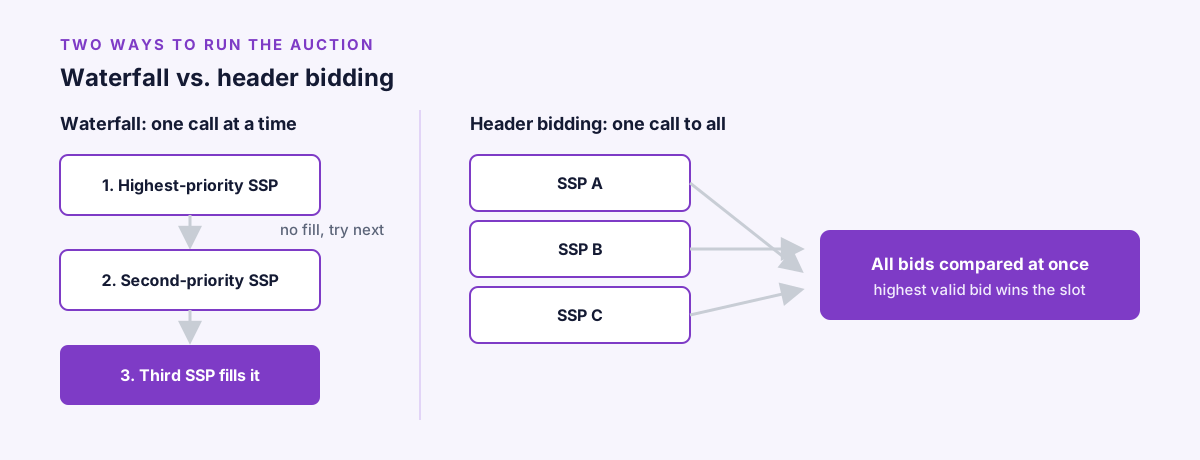
A waterfall calls buyers one at a time. Header bidding calls them all at once and compares every bid.
Header bidding fixed that by calling multiple SSPs and DSPs at the same time, outside the page’s normal priority order, and letting the single highest bid from any of them win. Most publishers today run header bidding through a small piece of code in the page’s header that manages those parallel calls, which is exactly where the technique gets its name.
How fast this actually happens
- A reader opens the page, and an ad slot needs filling.
- The publisher’s header bidding setup, or its ad server, calls the SSP.
- The SSP builds a bid request from the slot’s details and sends it to every connected buyer at once.
- DSPs and exchanges evaluate the opportunity and respond with bids, if they choose to bid at all.
- The SSP selects the highest valid bid, and that buyer’s ad renders on the page.

The same auction runs whether the ad slot sits on a website or inside a mobile app.
All of this typically finishes in well under a second, often in the low hundreds of milliseconds, which is part of why nobody notices it happening at all.
Beyond the open auction
Not everything an SSP handles is a free-for-all. Publishers can also set up private marketplaces (PMPs), invite-only auctions limited to a chosen list of buyers, often at a higher floor price than the open auction. A publisher running a PMP might, as an example, invite five specific advertisers to bid on its homepage slot at a floor of ten euros, instead of opening that slot to every connected buyer at whatever price the open market sets.
Some go further with programmatic guaranteed deals, where a specific buyer commits to a fixed volume at a fixed price in advance, closer to a traditional insertion order than an auction, except that the SSP still handles delivery and reporting automatically rather than leaving it to manual trafficking.
What publishers look for in an SSP
The questions below sound technical, but they add up to one practical outcome: whether a given impression sells for a fair price or gets wasted.
- Demand breadth: how many DSPs, trading desks, and direct buyers are actually connected and bidding.
- Latency: how fast the SSP responds to a bid request, since a slow response gets dropped from the auction entirely.
- Yield reporting: visibility into which demand sources are actually paying well, and which are dead weight.
- Brand safety tools: category and domain blocking that a publisher can actually trust.
- Integration: whether it fits cleanly into the publisher’s existing header bidding wrapper and ad server, without a rebuild.
FAQ
Is an SSP the same thing as an ad exchange?
Not quite. An ad exchange is closer to the marketplace itself, the place where bids are matched to impressions. An SSP is the publisher-facing layer that manages inventory, sets rules, and connects to one or more exchanges and DSPs on the publisher’s behalf.
Can a single website use more than one SSP?
Yes, and most larger publishers do exactly that, usually through header bidding, so that several SSPs compete for the same impression rather than each one getting a separate, smaller slice of traffic.
Does working with an SSP mean giving up control over who advertises on a site?
No. Brand safety tools let a publisher block specific advertisers, categories, or domains regardless of what they are willing to pay. The auction decides the price among allowed bidders, not which bidders are allowed in the first place.
Why would a publisher use a private marketplace instead of the open auction?
A private marketplace lets a publisher offer a specific buyer a higher floor price or a reserved slice of inventory, often in exchange for a stronger guarantee on delivery or a direct relationship, rather than relying purely on open competition.
How does an SSP make money?
Most SSPs take a percentage of the winning bid, a small fee layered into each cleared impression. The exact rate and how transparently it is disclosed vary from one SSP to another.
How Arago helps
Arago is a DSP, the buying side of the chain described above, built specifically for local retail. Understanding how an SSP runs its auction explains what is actually happening when Arago evaluates an impression on the open internet: a publisher’s SSP builds a bid request, Arago’s DSP decides whether that impression matches one of its advertiser’s rules, in real time, over OpenRTB, and bids accordingly.
That buying process stays within rules the advertiser sets directly: allow and block lists of sites and apps per line item, zones drawn in real driving time with Map, and frequency capping, so a retailer’s budget only ever meets the inventory it actually wants. Viewability is measured independently with the IAB Open Measurement SDK, and third-party tracking pixels can run alongside Arago’s own, so an advertiser can check every number the SSP’s auction ultimately produced. See pricing for what is included, free, from the first campaign.