A store opening only happens once. You cannot reschedule the ribbon-cutting because an auction did not clear in your favor that morning, and you cannot explain to a line of waiting customers that your ad budget got outbid. For moments like that, “probably” is not good enough. You need a deal that behaves less like a bet and more like a reservation.
That deal is called programmatic guaranteed.
Two old ideas, bolted together
Programmatic guaranteed (PG) borrows from two historically separate worlds. From the open auction, it keeps the automated pipes: no faxed insertion order, no manual trafficking spreadsheet, creatives and targeting set directly in a DSP, pacing adjusted the same way a regular campaign would be. From the traditional direct deal, it keeps the certainty: a fixed number of impressions, at a fixed price, reserved in advance for one buyer. What it drops is the auction itself. There is no bidding, no floor to clear, no risk of losing the slot to someone else’s budget at the last second.
That puts it at one end of a spectrum that starts with the open exchange, where anyone can bid on anything, runs through private marketplaces where a publisher invites a shortlist of buyers, and ends here, where one buyer simply reserves the inventory outright.
From handshake to delivery
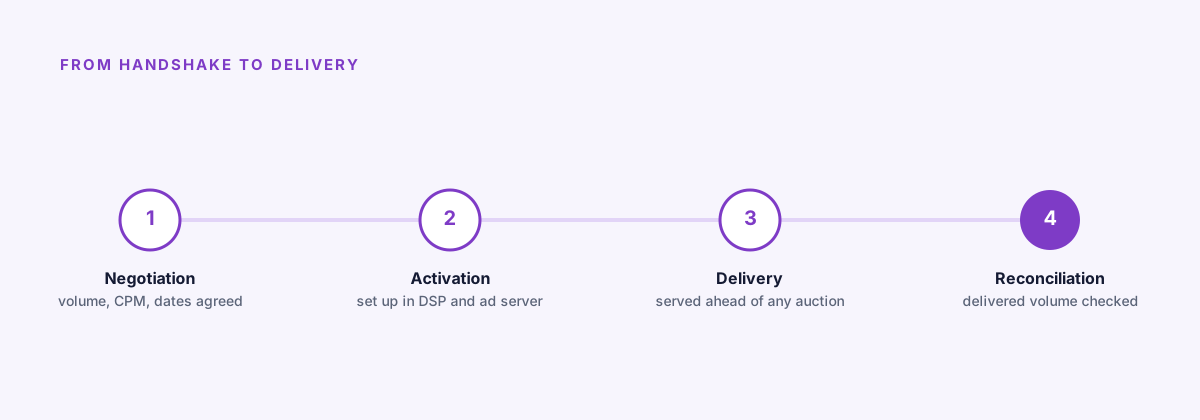
No auction in the middle: the price and volume are set before a single impression runs.
A PG deal moves through four stages. First, negotiation: buyer and publisher, or their representatives, agree on flight dates, targeting criteria, volume and CPM, the same way a traditional direct deal would start, except there is no auction waiting at the end of the conversation. Second, activation: the terms get configured in the DSP and the publisher’s ad server, and the publisher holds back the agreed inventory so it cannot be sold elsewhere in the meantime. Third, delivery: when a matching visitor shows up, the impression goes to the PG deal before it ever reaches an auction, and the DSP serves the agreed creative at the agreed price, with delivery tracked against the contracted volume as the flight runs. Fourth, reconciliation: both sides compare delivered impressions against the contract once the flight ends, and most agreements include a make-good, in extra impressions or a credit, if the publisher falls short.
An auction tells you what you might get. A guarantee tells you what you will get, and at what price.
Why certainty costs more
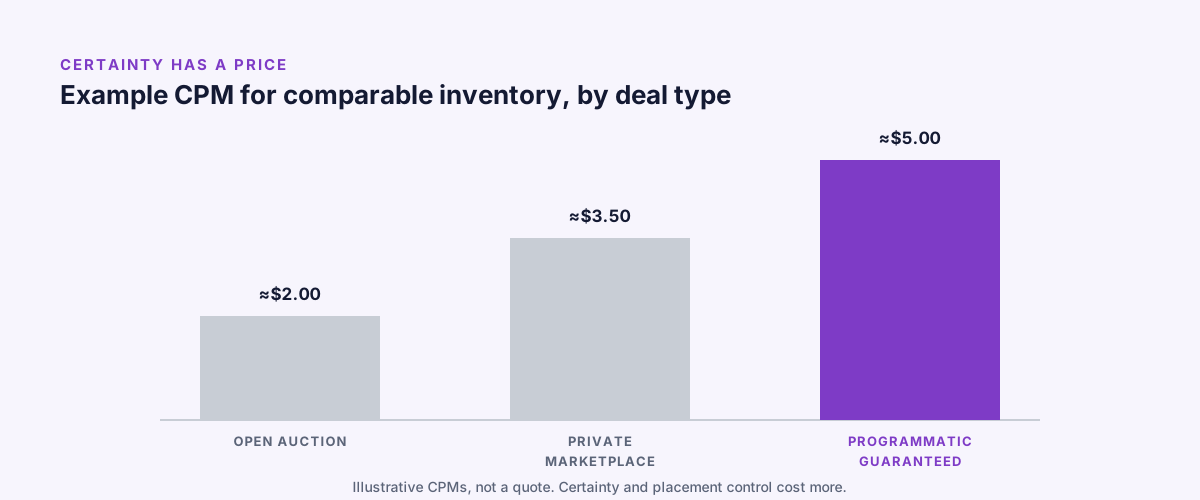
Illustrative example: the same inventory tends to cost more as the buyer asks for more certainty.

PG works backward from a date that cannot move, not forward from whatever the auction happens to clear.
A reserved seat costs more than standing room, and PG follows the same logic. Publishers typically charge a premium over open-auction rates for the certainty and the placement control they are handing over, which is exactly why PG tends to carry their best inventory, the kind they would rather not risk on the open exchange. Buyers get real benefits in return beyond just certainty: creatives can be swapped in the DSP without calling a publisher rep, and a buyer’s own first-party audience data can still filter who sees the ad within the reserved placement, so the guarantee does not have to come at the cost of relevance.
The catch
None of this comes free of trade-offs. The CPM premium means PG is rarely the cheapest way to chase a pure performance goal like cost per click or return on ad spend, since you are paying for certainty the campaign may not actually need. Under-delivery risk sits mostly with the publisher, but a buyer should still plan a buffer, because resolving a shortfall through a make-good or a credit takes time it may not have, especially for a deal tied to a single fixed date. And because the terms are fixed upfront, changing targeting or volume mid-flight means going back to the negotiating table rather than adjusting a dial in the DSP, which is the opposite of how an open auction campaign behaves.
When it earns its keep
PG tends to make sense when a specific, premium placement matters more than the lowest possible price: an above-the-fold homepage takeover, an app’s launch screen, a campaign tied to a fixed date that will not move. It also fits when brand safety requirements are strict enough that leaving placement to an open auction is not an option, or when a buyer specifically wants the predictability of a direct relationship without giving up the speed of programmatic tooling. For a pure performance campaign with flexible targeting, an open auction or a PMP will usually get there for less.
FAQ
Does programmatic guaranteed involve any bidding?
No. Price and volume are fixed in advance between buyer and publisher, and every eligible impression goes to the PG deal before it would ever reach an auction.
Is programmatic guaranteed more expensive than a PMP?
Generally yes. Publishers charge a premium for the certainty and placement control they hand over, since PG typically carries their best inventory.
Can targeting change mid-flight in a PG deal?
Not easily. Because terms are fixed upfront, changing targeting or volume usually means going back to the negotiating table rather than adjusting a setting in the DSP.
What happens if a publisher under-delivers a PG deal?
The publisher typically owes a make-good or a credit, but resolving a shortfall takes time, so buyers should still plan a buffer, especially for a date that will not move.
How Arago helps
Arago lets local retailers add a deal ID negotiated with a publisher for a programmatic guaranteed reservation to a line item, alongside open-exchange and private marketplace buying through the same allow and block lists: Arago does not curate or sell PG inventory itself, it is the retailer’s own negotiated deal. It runs through the same DSP used for everyday campaigns, with no contract and no minimum spend. A store opening, a seasonal sale, a moment that only comes once a year: a local business can reserve the placement for it the same way a national brand would, pair it with drive-time zones around the store through Map, and manage the rest of its pricing and targeting without ever leaving the platform.