Imagine a line of shoppers waiting to make an offer on the same item, one at a time. The person at the very back might be willing to pay the most of anyone in the line, but if the first three people ahead of them all say yes before the seller ever reaches them, nobody finds that out. The sale closes, and the best offer in the room never even got asked.
For years, that was roughly how digital ad inventory worked. Header bidding is the technique that tore up the line and asked everyone to bid at the exact same moment instead.
The problem header bidding solved
To understand why that change mattered, it helps to picture what came before it: the waterfall.
In a waterfall setup, a publisher’s ad server offered a slot to one demand source at a time, in a fixed, pre-agreed order. The top-ranked network got first right of refusal, at a price set in advance. If it declined, the slot fell to the next partner in line, and so on, down the list, until someone said yes or the inventory went unsold.

The waterfall asked buyers to wait their turn: whoever stood first in line got the first (and often the only) look.
That order rarely had anything to do with who actually valued the impression most. A buyer ranked fourth or fifth might have paid more than anyone above them, but the slot was often already gone by the time it reached them. Publishers left money on the table, buyers with real demand got locked out, and almost nobody in the chain had a clear view of what the inventory was genuinely worth.
A waterfall only ever finds out what the first few buyers were willing to pay. It never learns what the fifth one would have offered.
What header bidding actually is
Header bidding (also called pre-bid or advance bidding) replaces that single-file line with a starting gun. Multiple demand sources, DSPs, ad networks, direct buyers, are invited to bid on the same slot at the same moment, before the publisher’s own ad server makes any final call.

Instead of one buyer at a time, every lane starts together: the same slot, offered to every demand source at once.
Side by side, the shift is stark. In the old model, the publisher asks one partner at a time, in a fixed order, and every refusal costs a little revenue nobody ever recovers. In header bidding, every demand source answers the identical request at the identical instant, and the slot goes strictly to whoever wants it most, not to whoever happened to be asked first.
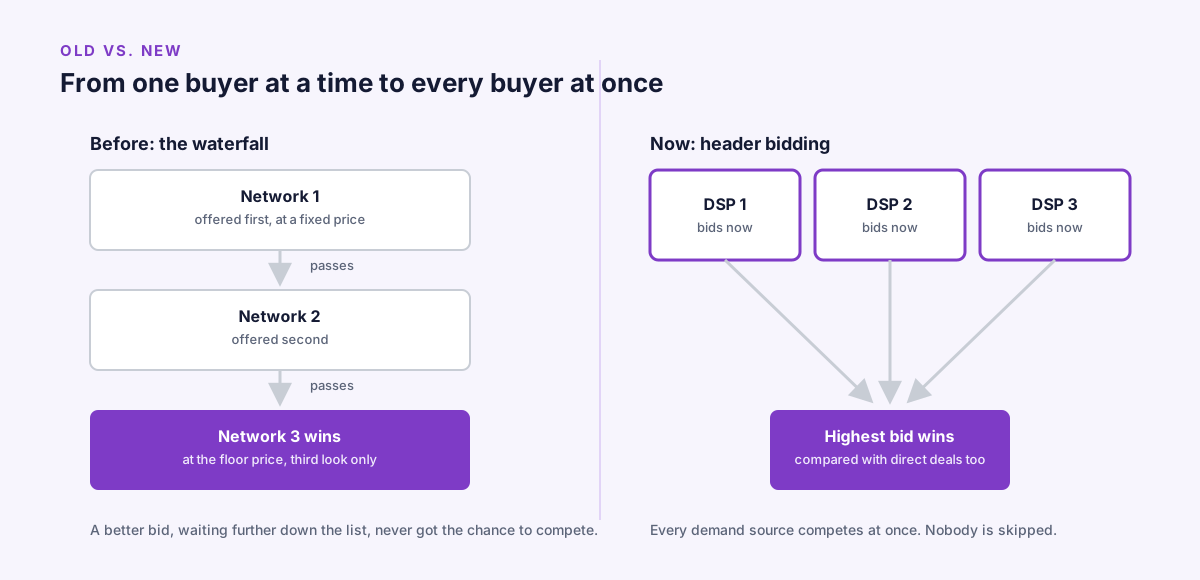
Side by side: the old waterfall asked one buyer at a time, in a fixed order, while header bidding asks everyone at once.
A typical page load with header bidding runs through a short, strict sequence:
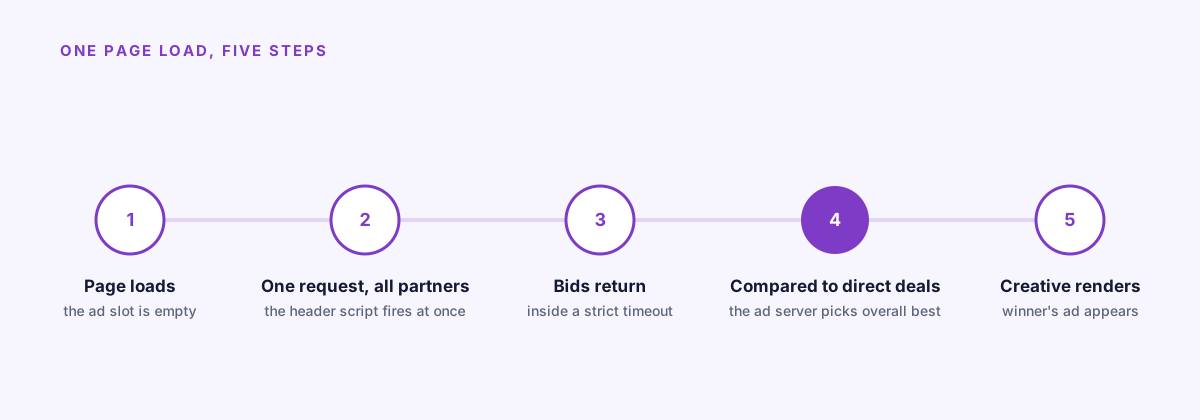
From an empty slot to a rendered ad, header bidding compresses what used to be a sequence of turns into a single round.
- A visitor’s browser loads the publisher’s page.
- A script sitting in the page header sends a bid request to every connected demand partner simultaneously.
- Each partner answers within a strict timeout, often a few hundred milliseconds.
- The highest bid that came back is handed to the publisher’s own ad server, which compares it against anything sold directly.
- The overall winner, whichever source offered the most, gets to render its creative.
Because every demand source answers the same question at the same time, the publisher ends up with something closer to a true market price for each impression, instead of whatever the first buyer in line happened to be willing to pay.
Where the auction actually runs: browser or server
The earliest implementations ran entirely inside the visitor’s browser (client-side). It worked, but it came with a cost: every extra demand partner meant another request the browser had to wait on, which could visibly slow a page down if too many were added.
Server-side header bidding moves that fan-out logic off the browser. The visitor’s device makes a single call to a header bidding server, and that server is the one that contacts every demand partner in parallel, then hands back just the result. The browser does less work, and publishers can add far more partners without dragging down page speed.
Most large publishers today run a hybrid of the two: some partners client-side, others server-side, tuned over time for the best balance of yield and performance.
Open Bidding and unified auctions
Google’s Open Bidding (previously called Exchange Bidding) is a server-side approach that runs inside Google Ad Manager, letting outside ad exchanges and SSPs bid alongside Google’s own demand in one unified auction rather than a separate wrapper. Several other large SSPs offer comparable unified products.
The effect, in practice, is consolidation. A publisher that once had to configure and monitor half a dozen separate header bidding wrappers can increasingly manage most of that complexity through one or two unified auction integrations instead, part of a broader move toward supply path optimization: favoring the most direct, most efficient route to the same inventory.
What changed for publishers
- Higher CPMs, because genuine competition across every demand source replaces a fixed, pre-negotiated order.
- Less dependence on any single network, since no one partner holds a privileged first look anymore.
- Better fill rates for premium inventory that previously sat unsold while waiting for the right buyer to reach the front of the line.
- A clearer read on true demand, since every auction now shows what buyers were actually willing to pay, not just what the first one in line agreed to.
What changed for buyers
- Equal access, regardless of where a buyer would once have sat in an old waterfall hierarchy.
- More auctions won on merit, since the highest valid bid wins the slot rather than the first one offered.
- Cleaner pricing signals, because competitive, simultaneous auctions reveal something closer to an impression’s real value.
The trade-offs
Header bidding is not free of downsides. Client-side setups with many partners can still slow page loads, which affects both the reader’s experience and, for publishers, their search ranking: a page that takes an extra half second to finish loading because of eight separate bid requests is a real cost, not a theoretical one. Running several demand partner integrations at once also adds real operational work, since each one needs its own timeout, its own floor price and its own monitoring. And the industry still debates some of the finer points: auction mechanics, the role of bid shading, whether the format has fully delivered on the transparency it originally promised.
None of that has reversed the underlying shift, though. The core idea, that every buyer should get to answer the same question at the same time, has become close to the default expectation for how programmatic inventory gets sold.
FAQ
Is header bidding the same thing as real-time bidding?
They work together rather than compete. Real-time bidding is the auction mechanism itself, how a price gets set for one impression. Header bidding is the delivery method that decides which buyers even get invited to that auction, and whether they get to compete alongside direct deals rather than only after them.
Does header bidding slow down a website?
It can, particularly in older client-side setups with many demand partners all requesting bids inside the browser. Server-side header bidding and unified auction products exist largely to solve that problem, by moving the fan-out off the visitor’s device.
Why did the waterfall model fall out of favor?
Because it only ever revealed what the first few buyers in a fixed order were willing to pay. A higher bid sitting further down the list simply never got the chance to compete, which left real revenue unclaimed and locked out legitimate demand.
Do small or local advertisers benefit from header bidding?
Yes, indirectly but meaningfully. Because every demand source competes on equal footing rather than by position in a pre-set order, a smaller buyer with a genuinely strong bid for a specific impression has the same chance to win it as a much larger one.
What is Open Bidding?
It is Google’s server-side, unified auction product, run inside Google Ad Manager, that lets outside exchanges and SSPs bid alongside Google’s own demand in a single auction rather than a separate wrapper. Other major SSPs offer similar unified auction products of their own.
How Arago helps
As a DSP built for local retail, Arago connects to publishers and inventory sources through modern programmatic infrastructure, including header bidding and unified auction environments, so that local advertisers compete on equal footing for premium digital placements. Every one of your line items carries its own zone, allowed-site list and budget, checked in real time as each of these auctions clears, and the interactive formats in Creative are ready to render the instant one is won.