For most of digital advertising’s history, a banner was a rectangle with a picture and a logo in it. It sat on the page, did nothing, and hoped someone clicked. Rich media is the name for everything built on top of that flat rectangle: motion, interactivity, video, expansion, anything that gives a viewer a reason to actually look twice instead of scrolling past.
What formats count as rich media?
“Rich media” covers a wider range than the name suggests, and it is easier to understand as a spectrum running from barely-moving to fully interactive.
At the quiet end, animated display ads use CSS animation or a lightweight looping video to catch the eye, with nothing required from the viewer. A step up, expandable ads start at a normal banner size and grow into something larger on a hover or a tap, without ever navigating the reader away from the page they were already on. Video-in-banner units autoplay or offer a short clip inside the standard banner frame. Interstitials take over the full screen at a natural pause point, between articles or between app screens. Further along, playable ads hand the viewer a lightly interactive version of an app or a game to try before they download anything, a format that dominates mobile gaming install campaigns. Rewarded video trades a voluntary watch for in-app currency or content, and because nobody is forced to watch, completion rates tend to be high. At the far end, shoppable ads embed a product carousel, pricing, or a direct purchase flow inside the ad itself.
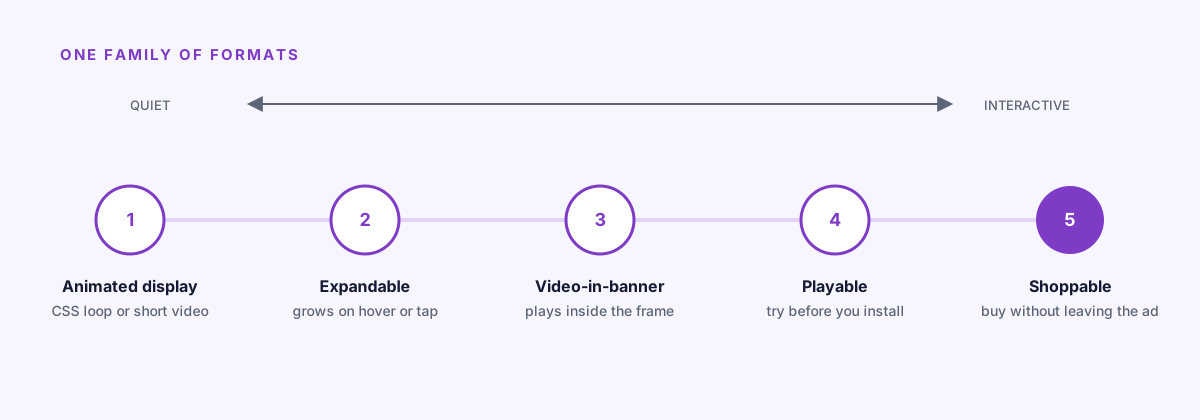
One family of formats, ranging from a quiet animation to something a viewer actually plays with.
Why does rich media outperform a static banner?
The engagement numbers for rich media are consistently better than their static equivalents, and the reasons are not mysterious. Motion and interactivity pull the eye in a way a flat image cannot. An expandable or interactive unit keeps someone’s attention for longer, which simply means more time for the message to land. A short video or an interactive product explorer can carry far more information than a headline and a logo ever could. And formats that ask a viewer to actually do something, tap, swipe, drag, consistently produce better brand recall than formats that only ask them to look.

A short video in the hand carries more of the message than a static banner ever could.
None of this is free. Rich media units generally cost more to build, take longer to produce, and need more careful testing across devices and browsers than a static image does.
A bigger format is not automatically a better one. It is a bigger bet on getting the craft right.
What rules does rich media have to follow?
The Interactive Advertising Bureau has published standards for this category for years, most visibly the LEAN principles: Light, Encrypted, support for AdChoices, Non-invasive. They matter for practical reasons, not just good citizenship. Publishers are more willing to run ads that meet them. Heavy or disruptive units damage the reading experience and are a direct cause of people installing ad blockers in the first place. And a growing share of programmatic environments now audit file size and behavior automatically before a creative ever gets to run.
HTML5 is the standard everything is built on today, having fully replaced the Flash-based formats of an earlier era, and most ad servers and programmatic platforms also support AMPHTML for accelerated environments.
How do you buy rich media programmatically?
Rich media can be bought the same way as a standard banner, through programmatic auctions, but the process carries a few extra considerations. The ad server on the receiving end has to support the format’s event tracking, expansion triggers and interaction reporting, not just a simple impression count. Not every publisher accepts every format, expandables in particular get restricted on mobile or limited to premium placements. Review times run longer, because interactive creatives typically need more scrutiny before they go live. And the reporting itself goes further than impressions and clicks, into interaction rates, video completion, expansion rates and time actually spent in view.

The moment a reporting dashboard is actually trying to capture: someone stopping to interact, not just scrolling past.
Which rich media format fits which goal?
Format choice should follow what the campaign is actually trying to do, not what looks most impressive in a deck.
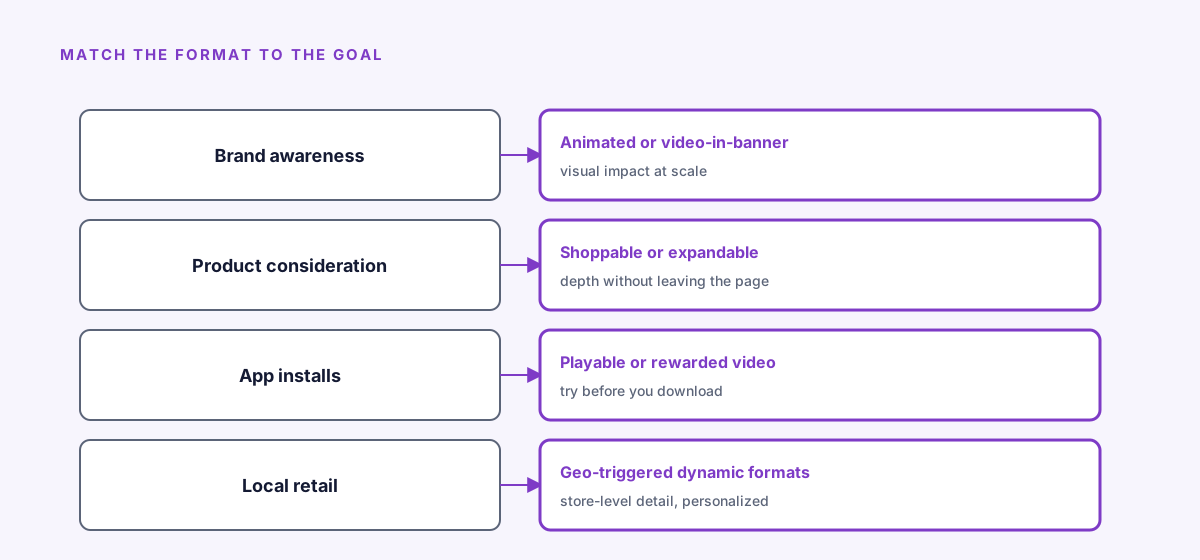
Four goals, four different formats: the right rich media choice depends on what the campaign needs to prove.
Brand awareness tends to favor animated or video-in-banner formats, which deliver visual impact at the scale a broad campaign needs. Product consideration leans toward shoppable or expandable units, which let someone go deeper without ever clicking off the page they were reading. App installs are the one place playable and rewarded video formats consistently beat standard video. And local retail is where geo-triggered dynamic formats earn their place, combining the rich media presentation with details specific to the viewer’s nearest store, the same mechanism covered in dynamic creative optimization.
FAQ
What’s the difference between rich media and a standard banner?
A standard banner is a static image. Rich media is everything built on top of that rectangle: motion, interactivity, video or expansion, built to give a viewer a reason to look twice.
Does rich media cost more than a static banner?
Yes. Rich media units generally cost more to build, take longer to produce, and need more careful testing across devices and browsers than a static image does.
What are the LEAN principles?
LEAN stands for Light, Encrypted, support for AdChoices, Non-invasive. The IAB publishes these standards, and publishers are more willing to run ads that meet them, since heavy or disruptive units damage the reading experience.
Can rich media be bought through programmatic auctions?
Yes, through the same auctions as a standard banner, but the receiving ad server has to support the format’s event tracking and expansion triggers, and review times tend to run longer for interactive creatives.
How Arago helps
Arago’s Creative tool builds interactive rich media formats, Scratch, Flip 3D, Reveal, Slider and Carousel, on a 320×480 canvas, free to build with no designer and no fee per ad. Each creative can personalize per viewer, the product, the offer, the nearest store, and launches directly alongside campaigns in the DSP. These same formats scale across a multi-store network, the pattern covered in local advertising at scale. For a look at how one of these formats actually gets built, read building playable rich media ads, or browse the full showcase.