Scroll through a news app for thirty seconds and count how many things you tapped on without checking whether they were an ad. If the number is not zero, you have already experienced native advertising working as intended.

Most of what fills a feed looks the same, whether it is a friend’s post, an article, or a paid placement.
An ad wearing the page’s clothes
Native advertising is a paid placement built to match the look, tone, and shape of whatever content sits around it, rather than standing apart from it like a banner. It is still clearly labelled as sponsored, that part is non-negotiable, but it is labelled quietly, the way a magazine marks an advertorial rather than wrapping it in flashing borders.
That labelling is required almost everywhere a reputable publisher operates. Regulators in most markets expect clear disclosure of paid content, and the networks that run native placements build the “Sponsored” or “Promoted” tag into the template itself rather than leaving it up to the advertiser. The goal of native is to persuade through relevance, placing a message where someone already has their guard down because the context is familiar, not to disguise the fact that money changed hands.
How one ad becomes many shapes
A native ad is not a single finished image. It is a small set of raw pieces: a headline, a short description, an image, a logo, a destination link. The publisher’s own platform then builds those pieces into whatever shape matches its page: an article card on a news site, a product listing on a shopping site, a post in a social feed.
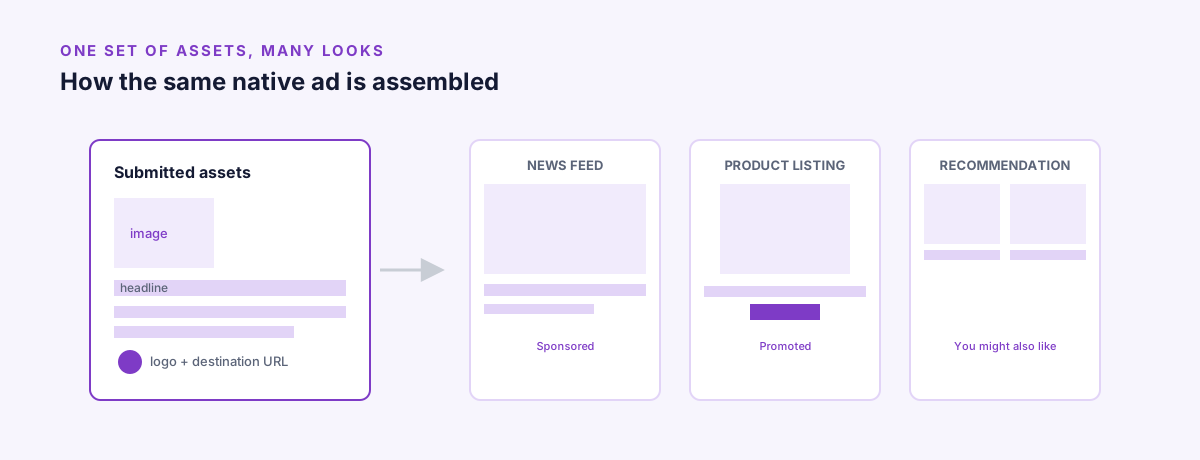
The same headline, image and link get rebuilt into three completely different-looking placements, depending on where they land.
That is the detail that makes native scalable in programmatic buying: nobody has to redesign a creative for every site it appears on. The ad server does the assembly. Write the headline once, and it shows up correctly everywhere it is placed.
Why do people stop filtering native ads out?
Standard display, a banner, an interstitial, a flashy rich media unit, sits in a fixed box that looks nothing like the page around it. People have learned to tune those boxes out so thoroughly the industry has a name for it: banner blindness.
You cannot out-shout banner blindness. You can only stop looking like the thing it learned to ignore.
Native sidesteps that entirely by looking like the content itself. On a news site it looks like an article card. On a marketplace it looks like a product tile. Because the shape matches expectations, people engage with it more than they do with a standard banner in most environments, not because the message is more persuasive, but because it does not get filtered before it is even read.
The trade-off is on the production side. A finished display creative is locked: one image, one layout, done. A native creative has to survive being rebuilt in different shapes, so the headline needs to work at 25 characters and at 90, and the image needs to hold up cropped to several aspect ratios.
Where does native advertising actually show up?
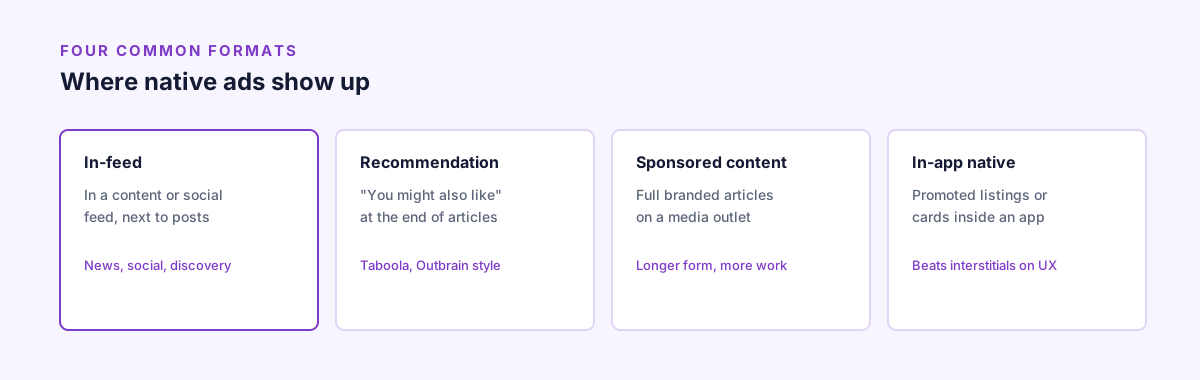
Four shapes, one underlying structure: headline, image, description, link.
- In-feed ads: the most common format, sitting directly inside a content or social feed, indistinguishable at a glance from an organic post.
- Recommendation widgets: the “you might also like” grid at the bottom of an article, popularised by networks like Taboola and Outbrain. Some of the links are editorial, some are paid.
- Sponsored content and branded articles: full-length pieces produced by or with a brand and published on a media outlet. More expensive to produce, but capable of real engagement and credibility when done honestly.
- In-app native: promoted listings or content cards inside an app, which tend to satisfy users more than an interstitial that blocks the whole screen.
Why does native suit a local shop particularly well?
A generic banner on an unrelated page rarely does much for a neighbourhood business. The same message, appearing as a native card inside a local news feed, lands in a context the reader already trusts.

Local news, read in a local moment: the context native advertising is built to fit into.
A few reasons this matters specifically for local retail, especially when native runs as part of contextual targeting rather than in isolation:
- The message shows up inside editorial environments readers already trust, rather than on top of them.
- The component-based structure makes it realistic to tailor messaging to local context without producing dozens of unique creatives by hand.
- In-feed placements on local news sites reach people at the moment they are actively reading about their own area, which is a useful moment to be nearby.
How do you measure native advertising beyond the click?
Standard click-through rate does not mean much for native, because native usually earns awareness and consideration rather than an immediate click. A few metrics carry more signal:
- Time on site after the click: did the visitor actually read anything, or bounce immediately?
- Scroll depth: for sponsored articles, how much of the piece did people actually get through?
- View-through conversions: did someone exposed to the ad convert later, without ever clicking it?
- Foot traffic lift: for local retail, did exposure line up with more people walking in the door?
FAQ
Is native advertising the same as content marketing?
No. Content marketing is a brand’s own editorial content, usually unpaid media. Native advertising is a paid placement, built to match a publisher’s layout, that always carries a sponsored label.
Does a native ad always have to be labelled as an ad?
Yes. The “Sponsored” or “Promoted” tag is non-negotiable almost everywhere a reputable publisher operates, and most ad networks build it into the template itself rather than leaving it up to the advertiser.
Why does a native headline need to work at several lengths?
Because the same submitted assets get rebuilt into different shapes on different pages: a 25-character headline fits a compact card, while a 90-character one might be needed for a wider article layout.
Is an in-feed native ad the same as a recommendation widget?
No. In-feed native sits directly inside a content or social feed and looks like a normal post. A recommendation widget is the separate “you might also like” grid, usually at the bottom of an article.
How Arago helps
Today, Arago runs display and interactive rich media campaigns for local retailers, with zones built in Map and formats built in Creative. Native placements are on the roadmap, so a retailer already using Arago for display will be able to extend the same campaigns into native environments without adopting a separate tool.