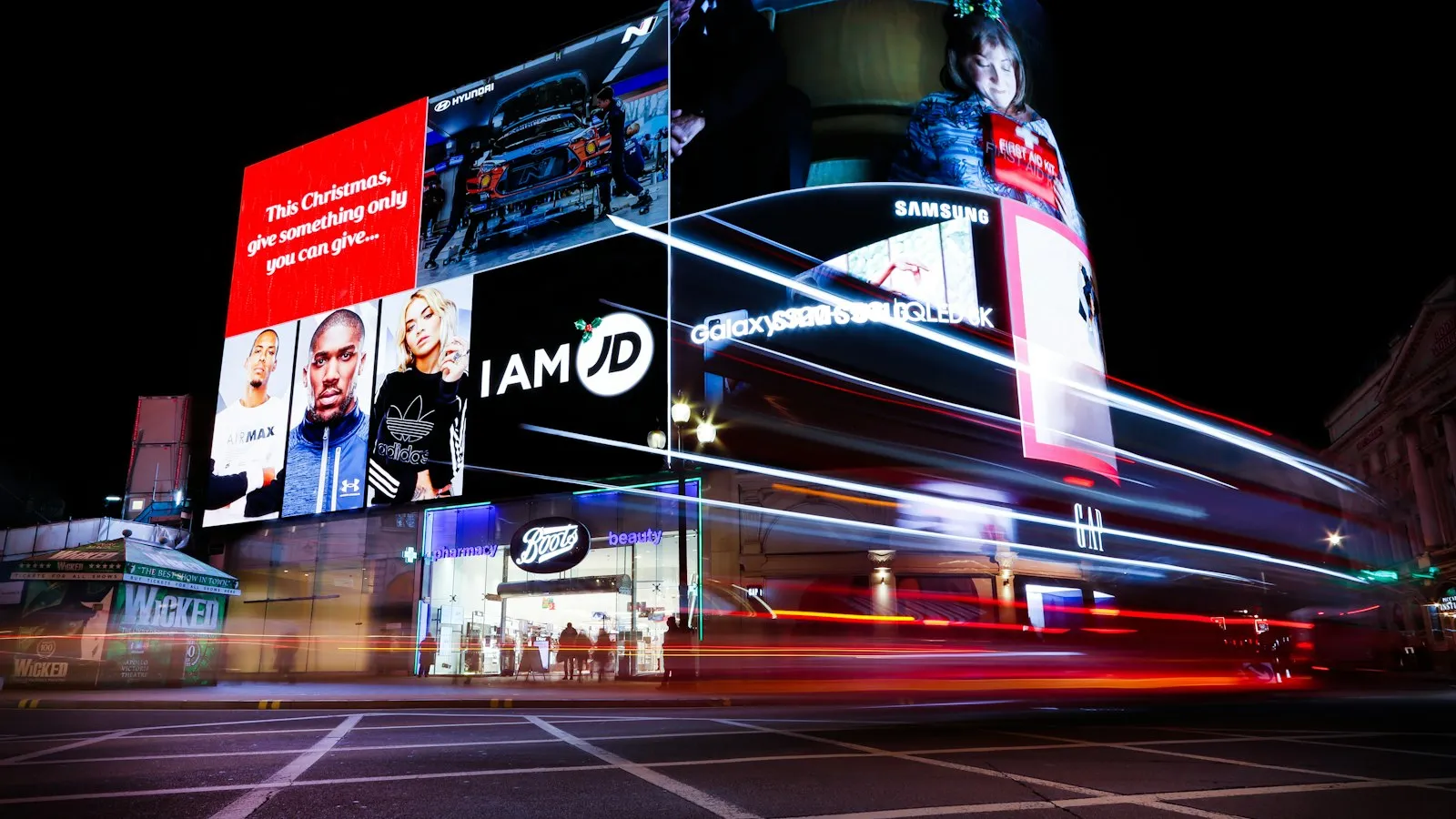
On her way to work, she walks past a digital billboard for a furniture store. At lunch, scrolling on her phone, a sponsored post from the same store shows up in her feed. That evening, reading a news site, a display ad follows up with a specific offer. She never searched for a sofa. The sofa found her, three times, in three different places.

Nobody experiences advertising one channel at a time. A day includes a screen, a feed, a street and a storefront, often from the same brand.
That is the territory an omnichannel advertising strategy lives in. The word gets used loosely, often to mean nothing more than “we run ads on several platforms.” In practice it means something more specific: the same brand voice, one shared idea of who you are reaching, and measurement that treats those three touchpoints as one campaign instead of three unrelated ones.
Why the furniture store cares
If those three touchpoints told inconsistent stories, different visuals, different offers, no sense that they came from the same campaign, the shopper’s experience would be an advertising mess rather than a story. The stores that get this right do not just spend more. They spend the same, better coordinated.
A shopper does not experience your channels. They experience your brand, one touchpoint at a time, and notice when the touchpoints disagree.
For local retail specifically, there is a second layer to this: closing the gap between a screen and a storefront. Digital advertising that actually drives someone through the door is the real objective for most local retailers, and getting there usually means pairing channels that build awareness (video, connected TV, digital out-of-home) with channels that catch the resulting intent (retargeting display, native, search-adjacent placements).
Starting from one audience, not five
The foundation underneath all of this is a single, clear definition of who you are trying to reach, applied the same way across every channel rather than rebuilt from scratch for each one. Whether that audience is built on geographic zones, behavioural signals, a CRM list or lookalike modelling, the point is consistency: the same person should not be treated as three different strangers depending on which platform happens to be running the ad.
That consistency does two practical things. It stops you paying to reach the same person with contradictory messages on different platforms, and it is the only way cross-channel frequency management is even possible.
Giving each channel a job
Not every channel is trying to do the same thing, and treating them as if they were wastes money on both ends. A practical way to assign roles:
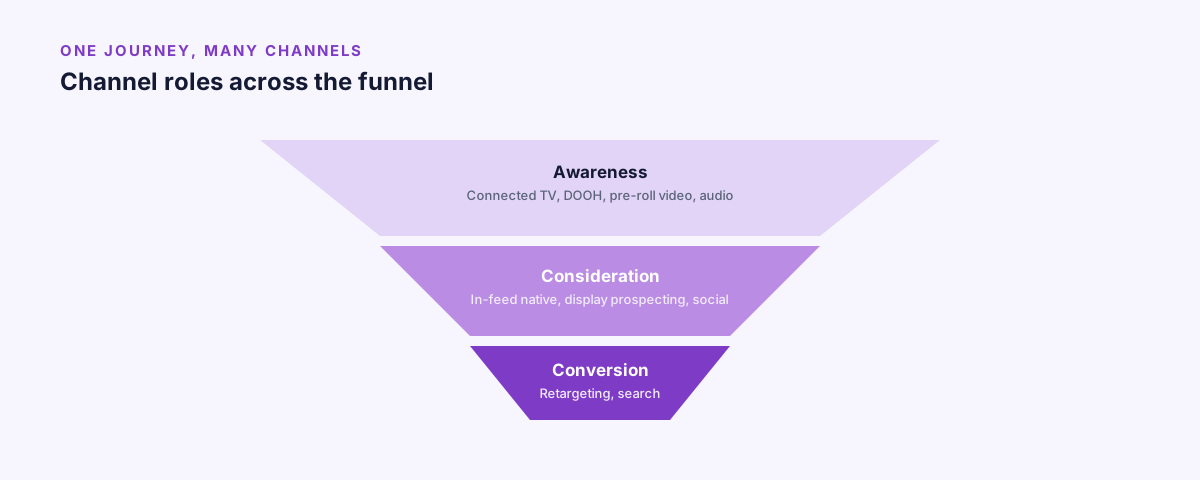
Each stage of the funnel calls for a different kind of channel, and a different kind of message.
- Awareness: connected TV, digital out-of-home, pre-roll video, audio. High reach, low interaction, built to introduce the brand to people who have not encountered it yet.
- Consideration: in-feed native, display prospecting, social. More room for detail, aimed at people who already have some awareness and need a reason to look closer.
- Intent and conversion: retargeting display, search-adjacent native, local inventory ads. Aimed squarely at people already showing a buying signal.
These do not run as isolated silos. Someone who saw a connected TV spot is measurably more likely to engage with a retargeting ad afterward, so sequencing the creative to reflect that order (introduce, then remind, then close) is most of what “omnichannel execution” actually means in practice.
One identity, five different outfits
Omnichannel does not mean identical creative everywhere. A 30-second connected TV spot, a 6-second bumper, a native headline and a DOOH board will all look quite different from each other. What has to hold constant is the identity underneath: the logo, the colour palette, the tone, the core offer. Each time someone meets the brand on a different screen, that consistency is what makes the exposures add up instead of resetting to zero.
How do you measure an omnichannel campaign?
Here is where most omnichannel strategies quietly fall apart. Each channel typically comes with its own dashboard and its own attribution logic, which makes it almost impossible to tell how they actually work together.
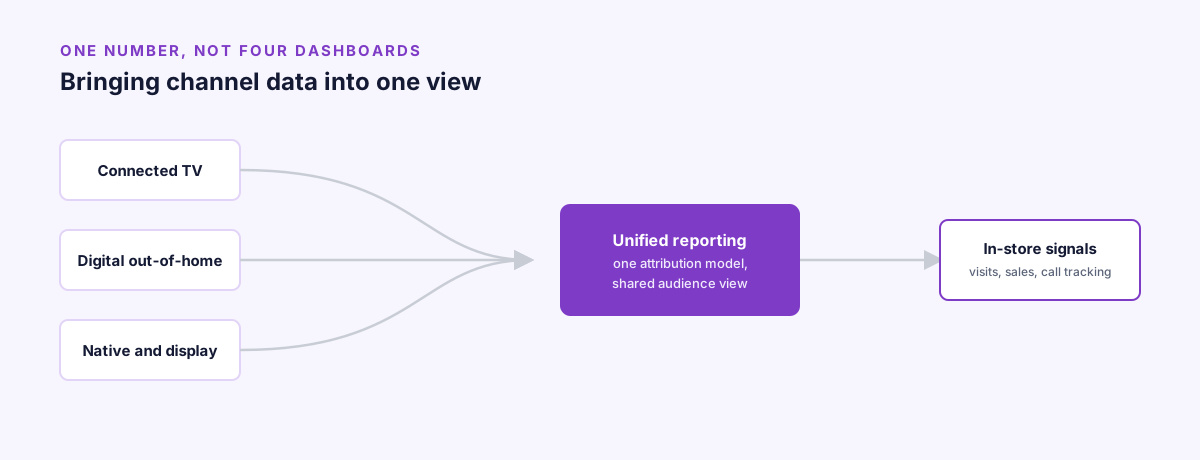
Each channel keeps its own report by default. Omnichannel measurement means pulling them into one view, including what happened offline.
A few practices that actually help:
- Centralising campaign data in a single reporting layer instead of four separate logins.
- Applying one consistent attribution model across channels, rather than letting each platform claim its own credit.
- Running incrementality tests to see what a channel actually added, rather than trusting what it says about itself.
- For local retail, pulling foot traffic and in-store sales into the same view as the digital numbers.

The outcome that actually matters for a local retailer rarely shows up in a digital dashboard on its own.
Where do omnichannel strategies usually go wrong?
Channel silos. When different teams or vendors run each channel with no shared plan, you get inconsistent messaging, duplicated audiences, and reports that cannot be reconciled with each other.
Trusting the last click too much. Last-click attribution hands all the credit to whichever touchpoint happened right before a conversion, which makes every upper-funnel channel look worthless even when it did the actual work of creating interest.
Ignoring what happened offline. For local retail, a scorecard that only counts clicks and digital conversions misses the entire point. Store visits, in-store transactions and call tracking are not secondary data, they are often the actual goal the digital campaign exists to support.
FAQ
What is omnichannel advertising, exactly?
Omnichannel advertising means running channels like connected TV, display, native and digital out-of-home as one coordinated campaign: one audience definition, one consistent brand identity, and one shared view of performance, rather than several disconnected efforts.
Is omnichannel the same as multichannel?
No. Multichannel just means running ads on more than one channel. Omnichannel adds the coordination: consistent audience, consistent brand voice, and unified measurement across every channel involved.
How many channels does an omnichannel strategy need?
There is no fixed number. What matters is that each channel included has a clear funnel role, awareness, consideration or conversion, rather than every channel trying to do the same job at once.
Do I need a big budget to run an omnichannel strategy?
No. Coordination, not spend, is what makes a strategy omnichannel. A small, well-sequenced set of channels pointed at one consistent audience beats a larger budget split across channels that do not talk to each other.
How Arago helps
Today, Arago runs display and interactive rich media from one place, with audiences and zones drawn in Map or imported as GeoJSON staying consistent across every line item, and reporting showing impressions, clicks and spend so you can see what actually worked. Video, connected TV, native and DOOH are on the roadmap, which is when an omnichannel strategy in the fuller sense becomes possible from the same account.